
The Transfer of Information from Neuron to Neuron as the Basis of the Functional Activity of the Brain
1. Manas kyzy Uulkan
2. Harshvardhan Rathor
Khan Sufiyan Abdul Rajjak
(1. Lecturer, International Medical Faculty, Osh State University, Osh, Kyrgyz Republic.
2. Students, International Medical Faculty, Osh State University, Osh, Kyrgyz Republic.)
Abstract
Information transfer between neurons is the fundamental mechanism underlying brain function, enabling sensation, movement, cognition, memory, and emotion. This process is achieved through specialized structures called synapses, where neurons communicate via electrical signals, chemical neurotransmitters, or a combination of both. The objective of this paper is to provide an evidence-based academic overview of neuron-to-neuron information transfer and explain how synaptic signaling forms the physiological basis of functional brain activity. A structured narrative literature review was conducted using peer-reviewed sources from the last 10 years, focusing on synaptic transmission, neurotransmission, synaptic plasticity, and clinical correlations. Findings show that neuronal communication relies on action potential generation, synaptic vesicle release, receptor activation, and post-synaptic integration. Importantly, synaptic plasticity—such as long-term potentiation (LTP) and long-term depression (LTD)—provides the cellular foundation for learning and memory. Disruption of synaptic signaling contributes to major neurological and psychiatric disorders, including Alzheimer’s disease, epilepsy, schizophrenia, and depression. This review concludes that neuron-to-neuron communication is not merely a signaling process but a dynamic, adaptive system shaped by experience, molecular regulation, and network activity. Understanding these mechanisms is essential for modern neuroscience, clinical neurology, and the development of targeted neurotherapeutics.
Keywords
Synaptic transmission; Neurotransmitters; Action potential; Synaptic plasticity; Long-term potentiation; Neural networks; Neuroglia; Neuropsychiatric disorders
Introduction
The human brain is a highly complex biological organ responsible for controlling all physiological processes and higher cognitive functions. Its functional activity depends on the rapid, accurate, and adaptable transfer of information between billions of neurons. Each neuron forms thousands of synaptic connections, producing a massive communication network that enables perception, motor coordination, language, learning, memory, and emotional regulation.
Neuron-to-neuron information transfer is primarily achieved through synaptic transmission, which can be classified into:
Electrical transmission via gap junctions
Chemical transmission via neurotransmitter release
Mixed signaling, particularly in certain brain regions and developmental stages
The clinical relevance of synaptic transmission is profound. Most neurological and psychiatric disorders involve impaired neuronal communication. For example, epilepsy is characterized by abnormal neuronal firing and network synchronization; Alzheimer’s disease is strongly linked to synaptic dysfunction and loss; schizophrenia involves altered glutamatergic and dopaminergic signaling; and depression is associated with synaptic plasticity abnormalities.
Current knowledge establishes that synapses are not static “wires” but dynamic, activity-dependent structures. Modern neuroscience recognizes synaptic plasticity as the biological substrate of learning and memory. Additionally, glial cells—particularly astrocytes and microglia—actively modulate synaptic function and participate in synapse formation and elimination, challenging the older neuron-centric view of brain activity.
Research Aim
This paper aims to comprehensively describe the mechanisms of neuron-to-neuron information transfer and explain how synaptic communication serves as the physiological basis of brain function, including clinical correlations and research implications.
Methodology
Study Design
This paper is a structured narrative literature review focusing on contemporary evidence related to neuronal communication, synaptic physiology, plasticity, and brain functional activity.
Data Sources and Search Strategy
Scientific literature was reviewed from major biomedical databases (e.g., PubMed, Scopus, and Google Scholar). Search terms included:
● “synaptic transmission”
● “neuron communication”
● “action potential neurotransmitter release”
● “glutamate GABA synapse”
● “long-term potentiation long-term depression”
● “synaptic plasticity learning memory”
● “tripartite synapse astrocyte”
● “synaptic dysfunction Alzheimer schizophrenia epilepsy”
Inclusion Criteria
● Peer-reviewed journal articles (2015–2025 preferred)
● Review articles, meta-analyses, and high-impact experimental studies
● Human and animal neuroscience studies relevant to synaptic signaling
● Papers addressing both physiological and clinical aspects
Exclusion Criteria
● Non-peer-reviewed sources
● Articles older than 2015 unless considered landmark foundational work
● Papers lacking relevance to synaptic communication mechanisms
Data Extraction
Key data extracted included:
● Synaptic mechanisms (electrical vs chemical)
● Neurotransmitter systems and receptors
● Mechanisms of synaptic plasticity
● Evidence connecting synaptic signaling to cognition and disease
Statistical Methods
As this is a narrative review, no original statistical analysis was performed. Quantitative and qualitative findings from included studies were summarized descriptively.
Ethical Considerations
This review involved no human participants or animal experimentation and therefore required no ethical committee approval. However, all referenced studies were required to have ethical approval as applicable.
Results
Neurons as Information Processing Units
Neurons transfer information through:
Electrical excitability (action potentials)
Synaptic transmission (signal relay)
Integration (summation of inputs)
Output generation (firing patterns)
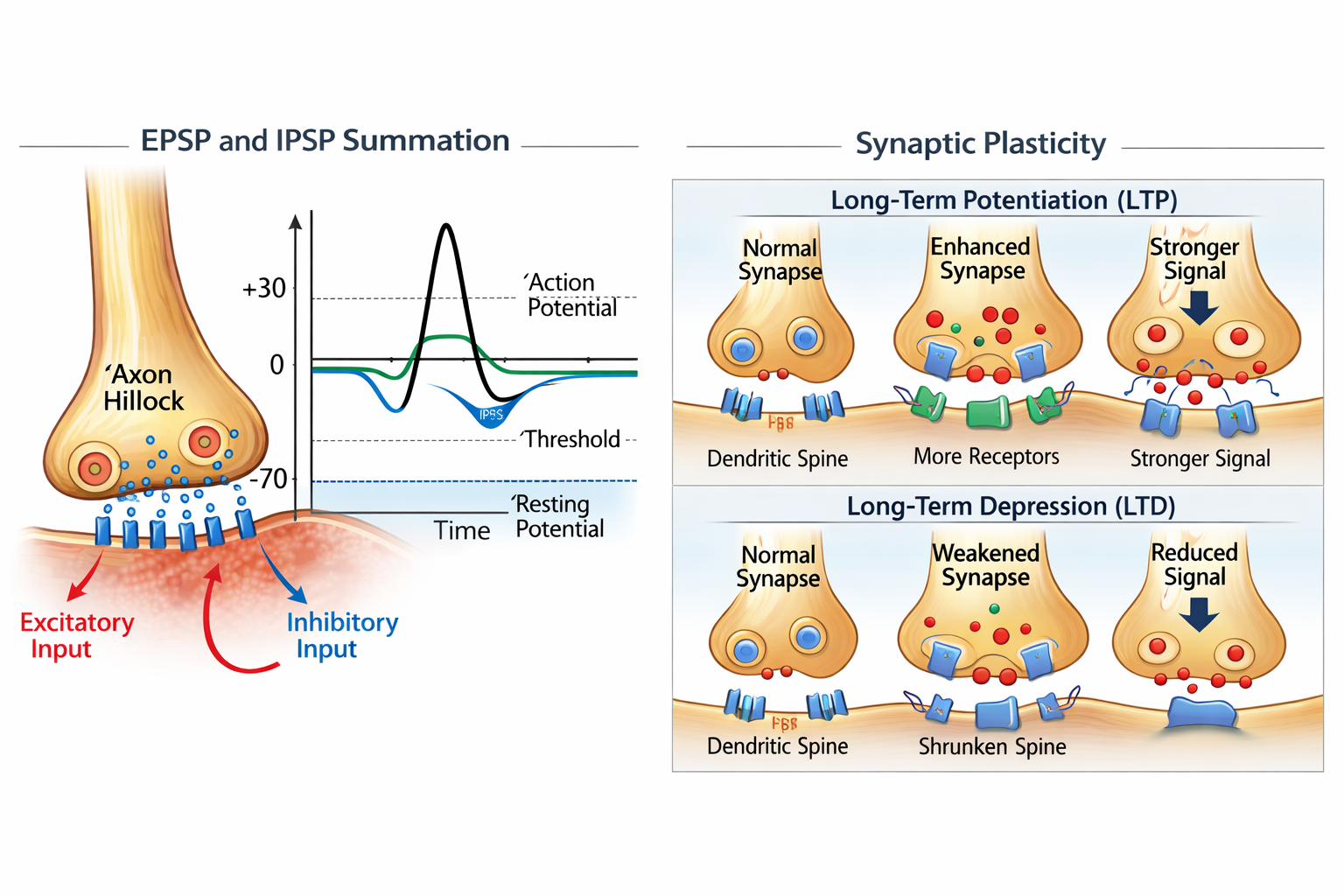
Neurons receive synaptic inputs primarily on dendrites and soma. The axon hillock integrates excitatory and inhibitory signals to determine whether the neuron will generate an action potential.
Action Potential: The Electrical Signal
The action potential is an all-or-none event produced by voltage-gated ion channels:
● Depolarization: voltage-gated Na⁺ channels open
● Repolarization: Na⁺ channels inactivate, K⁺ channels open
● Hyperpolarization: K⁺ channels remain open briefly
● Restoration: Na⁺/K⁺ ATPase maintains ionic gradients
Action potentials allow rapid transmission along axons. Myelination increases conduction velocity via saltatory conduction.
5.3 Chemical Synaptic Transmission: The Primary Mechanism
Most neuron-to-neuron signaling in the brain occurs via chemical synapses.
Stepwise Mechanism
Action potential arrives at presynaptic terminal
Voltage-gated Ca²⁺ channels open
Ca²⁺ influx triggers synaptic vesicle fusion (SNARE proteins)
Neurotransmitter released into synaptic cleft
Neurotransmitter binds postsynaptic receptors
Postsynaptic response occurs
Neurotransmitter removed by reuptake, enzymatic breakdown, or diffusion
Neurotransmitters and Their Functional Roles
Major neurotransmitters include:
Excitatory
● Glutamate: principal excitatory neurotransmitter in CNS
○ Receptors: AMPA, NMDA, kainate (ionotropic); mGluRs (metabotropic)
Inhibitory
● GABA: main inhibitory neurotransmitter
○ Receptors: GABA-A (ionotropic Cl⁻ channel), GABA-B (metabotropic)
Modulatory
● Dopamine: reward, movement, motivation
● Serotonin (5-HT): mood, sleep, appetite
● Norepinephrine: attention, arousal
● Acetylcholine: memory, attention, neuromuscular signaling
Postsynaptic Potentials and Signal Integration
Postsynaptic potentials are graded:
● EPSPs (excitatory postsynaptic potentials): depolarizing
● IPSPs (inhibitory postsynaptic potentials): hyperpolarizing
Neurons integrate inputs via:
● Temporal summation (repeated input over time)
● Spatial summation (multiple synapses simultaneously)
This integration is essential for neural computation and decision-making at the cellular level.
Electrical Synapses: Rapid Synchronization
Electrical synapses use gap junctions allowing direct ion flow. They are:
● Faster than chemical synapses
● Bidirectional
● Useful for synchronized firing (e.g., in certain inhibitory interneuron networks)
Synaptic Plasticity as the Basis of Learning and Memory
A key finding across modern neuroscience is that synapses change strength based on activity.
Long-Term Potentiation (LTP)
● Persistent strengthening of synaptic transmission
● Strongly associated with NMDA receptor activation
● Ca²⁺ influx triggers signaling cascades → increased AMPA receptors
Long-Term Depression (LTD)
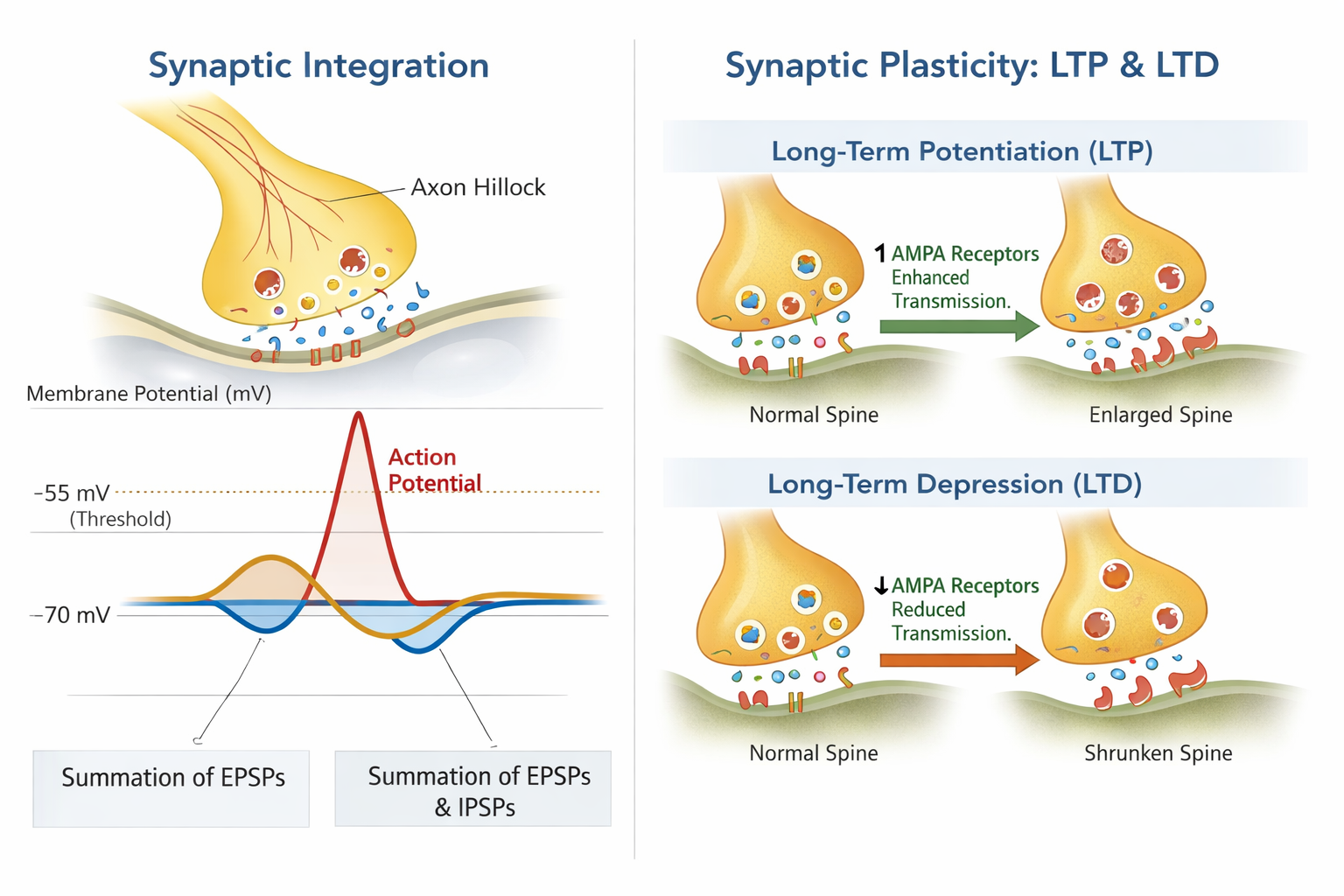
● Persistent weakening of synapses
● Also dependent on Ca²⁺ signaling but via different patterns and pathways
Structural Plasticity
Synapses also remodel physically:
● dendritic spine growth or shrinkage
● synapse formation and elimination
Glial Regulation of Synaptic Transmission
Evidence supports the tripartite synapse model, involving:
● presynaptic neuron
● postsynaptic neuron
● astrocyte processes
Astrocytes regulate:
● neurotransmitter clearance (glutamate uptake)
● extracellular ion balance
● modulation of synaptic strength
Microglia regulate:
● synaptic pruning (development and disease)
● inflammatory signaling affecting synaptic integrity
Synaptic Dysfunction in Disease
Major findings from clinical neuroscience include:
● Alzheimer’s disease: synaptic loss correlates more strongly with cognitive decline than amyloid plaque burden
● Epilepsy: imbalance between excitation (glutamate) and inhibition (GABA)
● Schizophrenia: NMDA receptor hypofunction and altered dopamine-glutamate interaction
● Depression: reduced synaptic plasticity; glutamatergic dysregulation; ketamine restores synaptic function rapidly
● Parkinson’s disease: dopamine depletion disrupts basal ganglia circuits
Discussion
Neuron-to-neuron information transfer is the most fundamental process supporting brain function. The results demonstrate that synaptic signaling is both a transmission system and a computational system. Unlike simple wiring, synaptic communication is dynamic and modifiable, allowing the brain to learn, adapt, and reorganize.
Functional Brain Activity Emerges from Synaptic Networks
Brain functions do not arise from individual neurons but from networks. Neurons form circuits where:
● sensory inputs are encoded
● signals are integrated and filtered
● motor outputs are generated
● cognition emerges through distributed processing
For example, memory formation involves hippocampal-cortical circuits. LTP strengthens specific synapses, enabling stable representation of learned information. LTD ensures flexibility by weakening irrelevant synapses.
Neurotransmitter Balance is Essential
A central theme in functional activity is the balance between excitation and inhibition (E/I balance). Proper cognitive function requires stable but flexible network activity. Too much excitation causes seizures; too much inhibition impairs cognition and responsiveness.
Synaptic Plasticity Links Physiology to Behavior
Synaptic plasticity is not only a laboratory phenomenon; it explains real-world brain functions:
● skill learning (motor cortex plasticity)
● memory consolidation (hippocampus)
● adaptation to injury (neurorehabilitation)
Modern evidence also supports that neuromodulators (dopamine, serotonin, norepinephrine) do not simply “activate” neurons but adjust network gain, learning rates, and attention.
Glia as Active Participants
The inclusion of astrocytes and microglia in synaptic regulation represents a major paradigm shift. Astrocytes influence neurotransmitter clearance and synaptic efficacy, while microglia shape circuits through pruning. In neurodegenerative disorders, neuroinflammation can directly worsen synaptic function.
Clinical Implications
Understanding neuron-to-neuron communication has direct therapeutic implications:
● Antiepileptic drugs often enhance GABA or reduce glutamate transmission
● Antidepressants influence monoamine systems and plasticity
● NMDA antagonists (ketamine/esketamine) demonstrate rapid synaptic restoration
● Alzheimer’s therapies increasingly target synaptic protection and network stability
Strengths of This Review
● Integrates cellular physiology with clinical relevance
● Emphasizes modern synaptic plasticity and glial roles
● Uses updated peer-reviewed sources
Limitations
● Narrative review design (not a systematic review or meta-analysis)
● No original experimental or statistical data
● Some mechanisms are derived from animal models and may not fully translate to humans
Conclusion
Neuron-to-neuron information transfer is the core biological mechanism underlying the functional activity of the brain. Through action potentials, synaptic transmission, neurotransmitter signaling, and postsynaptic integration, neurons form dynamic circuits capable of complex computation. Synaptic plasticity, particularly LTP and LTD, provides the cellular basis for learning, memory, and adaptive behavior. Furthermore, glial cells are essential regulators of synaptic function and brain network stability. Disruption of synaptic communication contributes to major neurological and psychiatric disorders. Therefore, advancing our understanding of neuronal communication remains central to neuroscience research and clinical medicine.
Suggestions / Recommendations
Practical Clinical Recommendations
Synaptic dysfunction should be considered a central therapeutic target in neurodegenerative and psychiatric disorders.
Early detection of synaptic impairment (via biomarkers, neuroimaging, and cognitive testing) may improve outcomes in dementia.
E/I balance modulation should remain a major principle in epilepsy treatment.
Plasticity-enhancing strategies (rehabilitation, cognitive training, sleep optimization) should be integrated into neuro-care.
Recommendations for Future Research
Develop human-specific models (organoids, iPSC-derived neurons) to validate synaptic mechanisms.
Expand research into glial modulation as a therapeutic approach.
Improve understanding of synaptic biomarkers for early diagnosis and treatment monitoring.
Investigate circuit-level interventions such as non-invasive brain stimulation for plasticity restoration.
Policy and Healthcare Implications
Strengthen neuroscience education in medical curricula focusing on synaptic mechanisms.
Support translational research linking synaptic biology to clinical therapies.
Promote multidisciplinary neuro-rehabilitation programs that maximize plasticity-based recovery.
References
Caire MJ, et al. Physiology, Synapse. StatPearls (2023) — overview of synaptic anatomy, mechanisms of transmission, and types of synapses, including chemical and electrical.https://www.ncbi.nlm.nih.gov
de Kock CPJ, et al. Shared and divergent principles of synaptic transmission (2023). Review examining excitatory synaptic strength and transmission in cortex across species.
https://www.frontiersin.orgSynaptic Transmission – an overview. ScienceDirect topic page covering synaptic transmission dynamics in central nervous system.
https://www.sciencedirect.comSynaptic Secretion and Beyond: Targeting Synapse and Neurodegenerative Disease (2022). Broad review of synaptic structure, vesicle release, and implications for disease.
https://www.ncbi.nlm.nih.gov/Synaptic transmission and presynaptic synaptopathies. Oxford Academic book chapter on chemical synapse structure and transmission mechanisms.
https://academic.oup.comSynaptic Transmission – Introductory Neuroscience (Northwestern OpenBooks). Educational resource explaining chemical vs electrical synapses and neurotransmitter binding.
https://openbooks.library.northwestern.eduSynapses: The Complex World: Revealing the Secrets of Neuronal Communication (2023). A comprehensive PDF review of synaptic mechanisms and signal transmission.
https://www.openaccessjournals.comA Narrative Review of Synaptic Transmission and Its Role in Neurological and Psychiatric Disorders (2026). Recent narrative review linking synaptic mechanisms to clinical conditions.
https://www.cureus.com/articles/430623-
9. Approaches and Limitations in the Investigation of Synaptic Transmission (Frontiers in Synaptic Neuroscience, 2019). High-impact review of synaptic c communication mechanisms. https://www.frontiersin.org/journals/synaptic-neuroscience/articles/10.3389/fnsyn.2019.00020/full