
Amenorrhea
1. Aydarbek Kyzy A.
2. Pulkit Sharma
3. Prince Kumar
4. Sohil Ali
5. Raghav Sharma
6. Udayveer Singh
(Teacher, International Medical Faculty, Osh State University, Kyrgyzstan)
(Student, International Medical Faculty, Osh State University, Kyrgyzstan)
(Student, International Medical Faculty, Osh State University, Kyrgyzstan)
(Student, International Medical Faculty, Osh State University, Kyrgyzstan)
(Student, International Medical Faculty, Osh State University, Kyrgyzstan)
(Student, International Medical Faculty, Osh State University, Kyrgyzstan)
Abstract
Amenorrhea is a common gynecological condition characterized by the absence of menstrual periods and often reflects underlying disturbances in the neuroendocrine regulation of the female reproductive system. It may arise from abnormalities at the level of the hypothalamus, pituitary gland, ovaries, uterus, or outflow tract. Amenorrhea is broadly classified into primary and secondary forms, each with diverse etiologies ranging from congenital anomalies and genetic disorders to hormonal imbalances, systemic diseases, and lifestyle factors. This review discusses the classification, pathophysiology, clinical features, diagnostic evaluation, and management of amenorrhea, emphasizing the importance of early recognition to prevent long-term complications such as infertility, osteoporosis, and metabolic disorders.
Keywords
Amenorrhea, Primary amenorrhea, Secondary amenorrhea, Hypothalamic–pituitary–ovarian axis, Menstrual disorders, Gynecology
Introduction
Menstruation is a vital indicator of normal reproductive and endocrine function in women. The menstrual cycle is regulated by a finely tuned interaction between the hypothalamus, pituitary gland, ovaries, and uterus. Disruption at any level of this axis can result in amenorrhea, defined as the absence of menstrual bleeding.
Amenorrhea is not a disease in itself but a clinical sign of underlying pathology. It may present as an isolated finding or in association with other symptoms such as infertility, galactorrhea, hirsutism, or systemic illness. A systematic approach is essential for accurate diagnosis and appropriate management.
Classification of Amenorrhea
Primary Amenorrhea
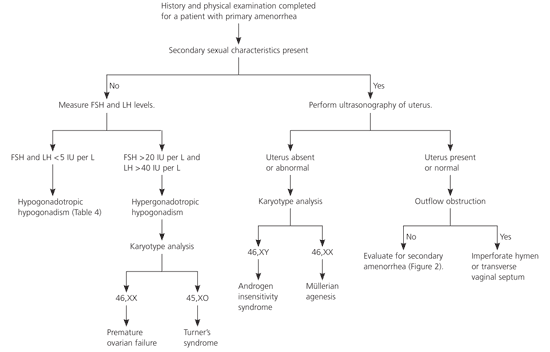
Primary amenorrhea is defined as:
Absence of menarche by 15 years in girls with normal secondary sexual characteristics, or
Absence of menarche by 13 years without secondary sexual characteristics.
Secondary Amenorrhea
Secondary amenorrhea is defined as:
Absence of menstruation for 3 consecutive cycles or 6 months in a previously menstruating woman.
Etiology
Primary Amenorrhea
Gonadal dysgenesis (e.g., Turner syndrome)
Mullerian agenesis
Hypothalamic or pituitary disorders
Congenital adrenal hyperplasia
Androgen insensitivity syndrome
Secondary Amenorrhea
Pregnancy (most common cause)
Hypothalamic dysfunction (stress, weight loss, excessive exercise)
Hyperprolactinemia
Polycystic ovary syndrome (PCOS)
Thyroid disorders
Premature ovarian insufficiency
Uterine causes (e.g., intrauterine adhesions)
Pathophysiology
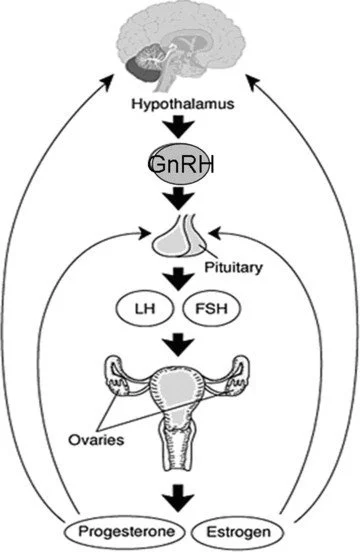
Amenorrhea results from disruption of the hypothalamic–pituitary–ovarian (HPO) axis. Reduced or absent gonadotropin-releasing hormone (GnRH) secretion leads to decreased follicle-stimulating hormone (FSH) and luteinizing hormone (LH) levels, impairing ovarian estrogen production and ovulation. Alternatively, ovarian failure or uterine abnormalities may prevent normal endometrial development and shedding despite intact hormonal signaling.
Clinical Features
Absence of menstrual periods
Infertility
Galactorrhea
Hot flashes and vaginal dryness (hypoestrogenism)
Hirsutism or acne (hyperandrogenism)
Delayed or absent secondary sexual characteristics (primary amenorrhea)
Diagnostic Evaluation
A thorough evaluation includes:
History
Age at menarche
Menstrual pattern
Weight changes, exercise, stress
Drug history
Symptoms of endocrine disorders
Physical Examination
Body mass index
Secondary sexual characteristics
Signs of androgen excess
Thyroid and breast examination
Investigations
Pregnancy test
Serum FSH, LH, prolactin, and TSH levels
Estrogen and androgen levels
Pelvic ultrasound
MRI of the pituitary (if indicated)
Karyotyping in selected cases
Management
Management depends on the underlying cause:
Lifestyle modification (weight restoration, stress reduction)
Hormonal therapy (estrogen–progesterone replacement)
Dopamine agonists for hyperprolactinemia
Ovulation induction for infertility
Surgical correction for structural abnormalities
Treatment of systemic or endocrine disorders
Complications
Infertility
Osteoporosis
Cardiovascular risk
Psychological stress and reduced quality of life
Conclusion
Amenorrhea is a significant gynecological condition reflecting underlying neuroendocrine, ovarian, or uterine dysfunction. Early diagnosis and targeted management are crucial to prevent long-term reproductive and metabolic complications. A multidisciplinary approach involving gynecologists, endocrinologists, and reproductive specialists ensures optimal patient outcomes and improved quality of life.
References
1. Klein DA, et al. — Amenorrhea: A Systematic Approach to Diagnosis and Management. https://pubmed.ncbi.nlm.nih.gov/31259490/
2. Nawaz G — Amenorrhea. https://www.ncbi.nlm.nih.gov/books/NBK482168/
3. Practice Committee of the American Society for Reproductive Medicine —Current Evaluation of Amenorrhea. https://www.asrm.org/practice-guidance/practice-committee-documents/current-evaluation-of-amenorrhea/
4. Pitts S, DiVasta AD, Gordon CM — Evaluation and Management of Amenorrhea. https://jamanetwork.com/journals/jama/article-abstract/2786258
5. Newbery G — Amenorrhea in Adolescents. https://pm.amegroups.org/article/view/4922/html
6. Longdom Journal — An Overview of Amenorrhea: Causes and Treatment. https://www.longdom.org/open-access/an-overview-of-amenorrhea-causes-and-treatment-83923.html
7. StatPearls — Primary Amenorrhea. https://www.ncbi.nlm.nih.gov/books/NBK554469/
8. American Society for Reproductive Medicine — Current Evaluation of Amenorrhea (2006). https://www.sciencedirect.com/science/article/pii/S0015028206032638
9. Primary Amenorrhea — International Journal of Reproduction, Contraception, Obstetrics and Gynecology (IJRCOG). https://www.ijrcog.org/index.php/ijrcog/article/view/3673