
Strategies of Health Promotion and Disease Prevention
1. Kalybekova K.D.
2. Singh Khushi
Khan Tanaaz
Sable Aditya
(1. Teacher, Public Health Dept., International Medical Faculty, Osh State University, Osh, Kyrgyzstan.
2. Students, International Medical Faculty, Osh State University, Osh, Kyrgyzstan.)
Abstract
Background: Noncommunicable diseases (NCDs) killed at least 43 million people in 2021, representing 75% of non-pandemic-related deaths globally, with 82% of premature NCD deaths occurring in low- and middle-income countries (WHO, 2025). Simultaneously, vaccine-preventable diseases and preventable infectious outbreaks continue to challenge global health systems. Health promotion and disease prevention represent the most cost-effective pathways to reducing this immense burden.
Objectives: This article reviews the principal strategies of health promotion and disease prevention at primary, secondary, and tertiary levels; examines the WHO Global Action Plan for NCDs 2013–2030; evaluates immunization coverage data from WHO and UNICEF (2024); and explores emerging approaches including digital health, universal health coverage (UHC), and social determinants-based interventions.
Methods: A narrative review of peer-reviewed literature and data from WHO, UNICEF, PubMed/NCBI, The Lancet, PLOS ONE, and the Global Burden of Disease Study 2021 was conducted. Evidence was synthesized across prevention levels, risk factor categories, and population groups.
Conclusions: Multisectoral, evidence-based health promotion and disease prevention strategies — including the WHO 'Best Buys,' expanded immunization, digital health integration, and Health-in-All-Policies approaches — are essential to achieving the Sustainable Development Goals (SDG 3.4) and reducing the global disease burden. Sustained political will, equitable resource allocation, and intersectoral collaboration are indispensable to success.
Keywords: health promotion, disease prevention, noncommunicable diseases, immunization, social determinants of health, WHO Best Buys, universal health coverage, digital health, primary prevention
1. Introduction
Health promotion and disease prevention constitute the cornerstones of modern public health practice. Defined by the World Health Organization (WHO) through the landmark 1986 Ottawa Charter as 'the process of enabling people to increase control over, and to improve their health,' health promotion extends beyond clinical care into the social, economic, and environmental conditions that determine population health outcomes (WHO, 1986; Oxford Academic / Health Promotion International, 2025).
The global disease burden in the 21st century is dominated by noncommunicable diseases. According to WHO's Noncommunicable Diseases Fact Sheet (2025), NCDs — including cardiovascular diseases, cancers, chronic respiratory diseases, and diabetes — killed at least 43 million people in 2021, equivalent to 75% of non-pandemic-related global deaths. Of these, 18 million were premature deaths occurring before the age of 70 years, with 82% of these premature deaths concentrated in low- and middle-income countries (LMICs).
Concurrently, vaccine-preventable diseases continue to threaten progress. In 2024, WHO and UNICEF reported that while 85% of infants globally completed three doses of the diphtheria-tetanus-pertussis (DTP3) vaccine, over 14.3 million children remained 'zero-dose,' having never received a single vaccine dose (WHO/UNICEF Joint Release, July 2025). The year also saw 60 countries experience large or disruptive measles outbreaks — nearly double the number from 2022.
These dual epidemiological realities — the rise of NCDs and the persistent threats of vaccine-preventable infections — underscore the critical importance of comprehensive, integrated health promotion and disease prevention strategies. This article reviews the theoretical frameworks, global policy architectures, evidence-based interventions, and emerging innovations that define this field, drawing on authoritative data from WHO, UNICEF, PubMed, and allied scientific sources.
2. Conceptual Frameworks in Health Promotion
2.1 The Ottawa Charter (1986) and Its Enduring Legacy
The Ottawa Charter for Health Promotion, adopted at the First International Conference on Health Promotion in November 1986, remains the foundational global reference for health promotion policy. It identified five core action areas: (1) building healthy public policy, (2) creating supportive environments, (3) strengthening community action, (4) developing personal skills, and (5) reorienting health services. The Charter defined health as a positive concept, emphasizing social and personal resources as well as physical capacities (WHO, 1986).
In 2026, WHO/Europe marked the 40th anniversary of the Ottawa Charter, acknowledging that while its core principles — advocating for health-conducive conditions, achieving equity, and promoting multisectoral action — remain unchanged, the contexts in which they must be applied have grown increasingly complex. Digital determinants, climate change, economic inequality, and growing misinformation now shape the landscape in which health promotion must operate (WHO Europe, April 2026).
2.2 The Alma-Ata Declaration and Primary Health Care
The 1978 Alma-Ata Declaration established primary health care (PHC) as the foundation for achieving 'Health for All.' PHC integrates preventive, promotive, curative, and rehabilitative services within community settings, emphasizing equity and universal access. The Declaration's principles were subsequently linked to the Ottawa Charter's recognition of social determinants as integral to health for all (PMC/NCBI, 2017). Today, WHO's Universal Health Coverage (UHC) agenda continues to build on these foundations, with an estimated 567 million additional people covered by essential health services without catastrophic spending by 2025 compared to the 2018 baseline (WHO Results Report, April 2026).
2.3 The Social-Ecological Model of Health
Modern health promotion is grounded in the social-ecological model, which recognizes that health is shaped by an interacting web of individual, interpersonal, community, and societal factors. This framework guides multi-level intervention design — from individual behavioral counseling and peer education to policy-level taxation and legislative reform. Social determinants of health (SDH) — including income, education, housing, employment, and food security — are now recognized by WHO as the primary drivers of health inequity and are central to contemporary prevention strategies.
3. Levels of Disease Prevention
Public health organizes disease prevention into three interconnected levels, each addressing a different stage in the disease continuum. This framework, widely endorsed in peer-reviewed literature and applied globally, provides the structural basis for intervention design (Caswell J., Journal of Preventive Medicine, 2024; California Surgeon General's Report, 2020).
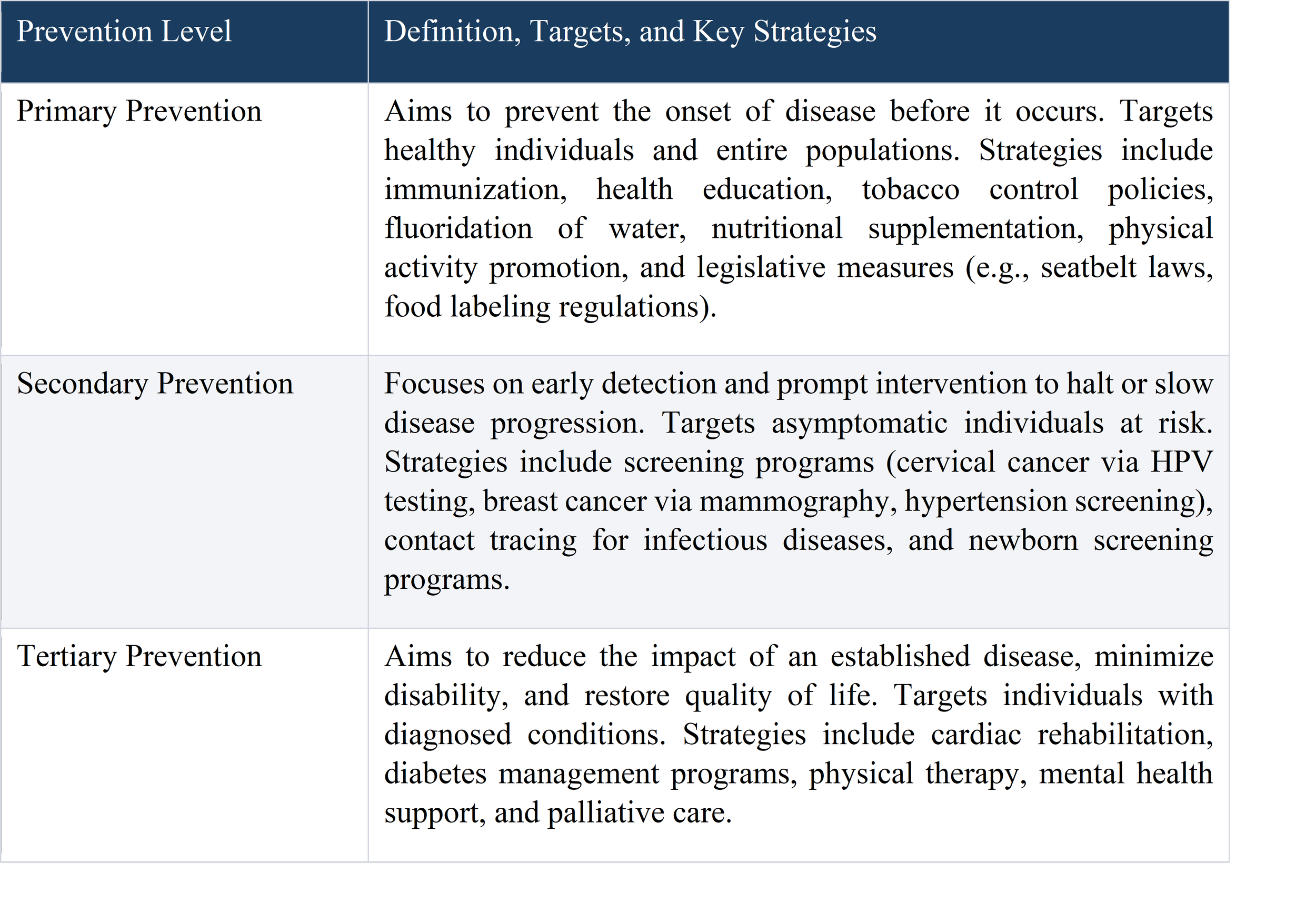
These levels are not mutually exclusive. Effective public health systems deploy all three simultaneously, creating layered protection across the disease spectrum. As noted by the National Academy of Medicine (2023), addressing prevention across a socio-ecological continuum — from individual risk reduction to structural policy change — produces the greatest and most sustained population health gains.
4. WHO Global Action Plan for NCDs 2013–2030
In 2013, the World Health Assembly endorsed the WHO Global Action Plan for the Prevention and Control of NCDs 2013–2020, subsequently extended to 2030. The Action Plan aims to reduce the preventable and avoidable burden of morbidity, mortality, and disability due to NCDs through a 'whole of government, whole of society' approach encompassing health-in-all policies (WHO, 2019; WHO EMRO, 2024).
4.1 Nine Global NCD Targets (2025/2030)
The Action Plan includes nine voluntary global targets, the most prominent being:
A 25% relative reduction in overall premature mortality from NCDs by 2025 (the '25 by 25' goal), extended to 33% by 2030 under SDG 3.4.
A 10% or more relative reduction in the harmful use of alcohol.
A 10% relative reduction in the prevalence of physical inactivity.
A halt in the rise of diabetes and obesity.
80% availability of affordable basic technologies and essential medicines for the treatment of major NCDs in both public and private facilities.
The WHO NCD Progress Monitor 2025 acknowledges that progress has recently slowed in several critical areas, including risk factor surveillance, national target setting, and public awareness campaigns. Obesity and diabetes continue to rise globally, and premature NCD deaths are increasing, especially in LMICs (WHO NCD Progress Monitor, 2025).
4.2 The 'Best Buys': Cost-Effective Prevention Interventions
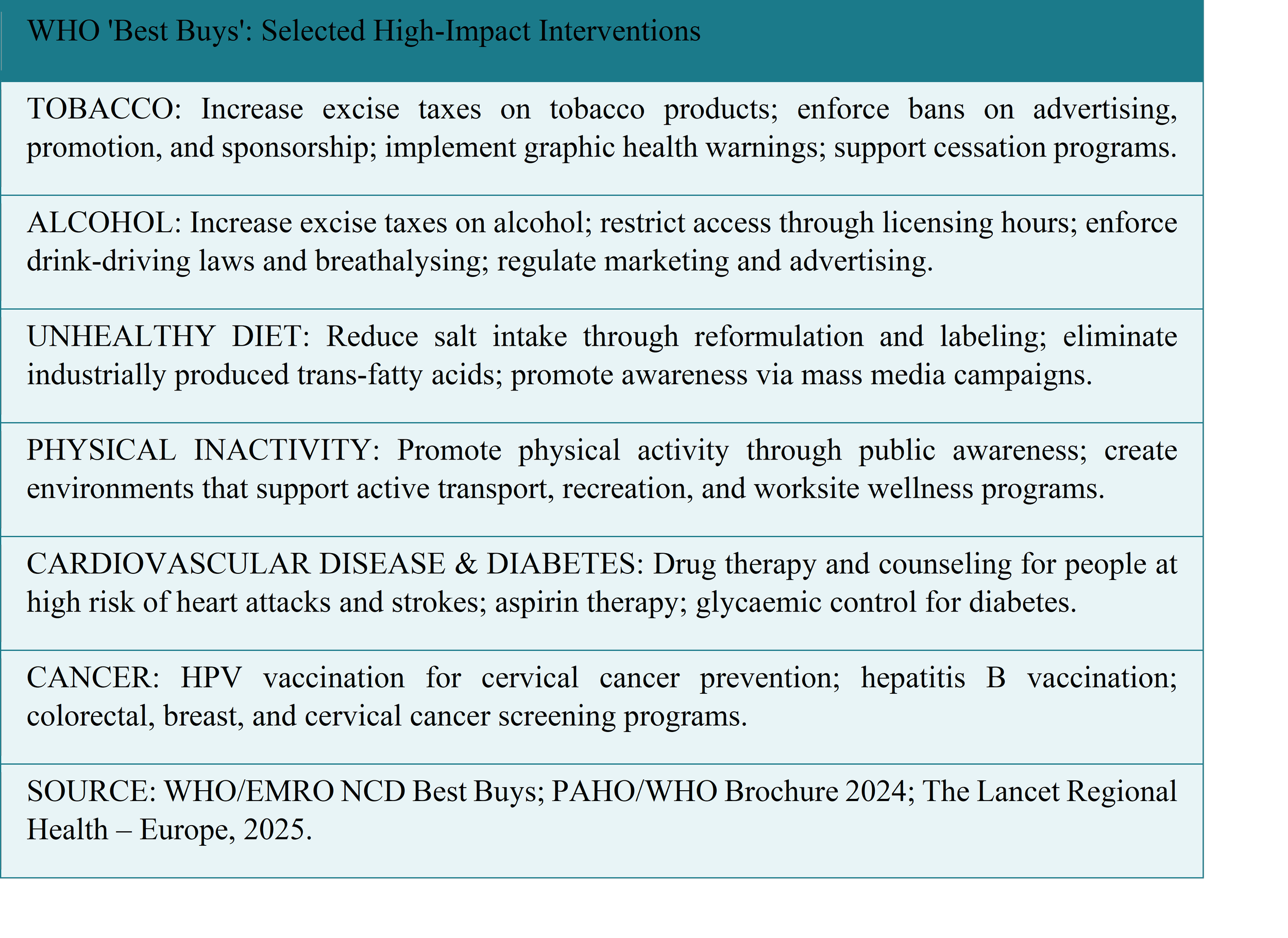
The WHO's 'Best Buys' represent a curated list of evidence-based, highly cost-effective interventions targeting the four key NCD risk factors: tobacco use, harmful use of alcohol, unhealthy diet, and physical inactivity. These address four major disease groups: cardiovascular disease, diabetes, cancer, and chronic respiratory disease (WHO EMRO; PAHO/WHO, 2024).
According to WHO South-East Asia Region analysis, 80% of heart diseases, strokes, and type 2 diabetes, and 30% of all cancers, could be prevented by eliminating the most common NCD risk factors. While NCDs cost LMICs nearly US$ 500 billion annually, the total annual cost of implementing all Best Buys is estimated at just US$ 11.4 billion — representing extraordinary value for health investments (WHO SEARO, 2014).
In 2025, WHO/Europe introduced the concept of 'Quick Buys' — a refined set of 25 interventions designed to deliver measurable population health impact within five years, aligning with typical political cycles. The two most broadly effective Quick Buys identified were: (1) increasing taxes and pricing on tobacco, alcohol, and unhealthy foods high in trans-fats, salt, and sugar; and (2) banning advertising and sponsorship of these products across all platforms including social media (WHO Europe, September 2024; JA PreventNCD, 2025).
5. Immunization: The Pillar of Primary Prevention
Vaccination is among the most cost-effective public health interventions ever developed. UNICEF estimates that the cost of a vaccine — often less than US$ 1 — is substantially lower than the expenses associated with treating a sick child or combating disease outbreaks (UNICEF Immunization Data, 2025).
5.1 Global Coverage: Progress and Gaps (2024)
According to the 2024 WHO and UNICEF Estimates of National Immunization Coverage (WUENIC), released in July 2025:
89% of infants globally (approximately 115 million) received at least one dose of the DTP-containing vaccine in 2024; 85% (109 million) completed all three doses.
Despite this, nearly 20 million infants missed at least one DTP dose, including 14.3 million 'zero-dose' children who received no vaccines at all — 4 million more than the 2024 target needed to stay on track with Immunization Agenda 2030 goals (WHO/UNICEF, July 2025).
84% of children received the first dose of the measles-containing vaccine (MCV1) — far below the 95% threshold needed to prevent outbreaks. In 2024, 60 countries experienced large or disruptive measles outbreaks, nearly doubling from 33 in 2022 (WHO/UNICEF, 2025).
HPV vaccine coverage reached 31% of eligible adolescent girls globally in 2024 — a substantial increase from 17% in 2019, though still well below targets (UNICEF; WHO/UNICEF Joint Release, 2025).
The 2024 data reveal a concerning pattern: approximately 10.2 million unvaccinated or under-vaccinated infants (51%) reside in countries with institutional and social fragility or conflict. In half of these fragile countries, zero-dose children rose sharply from 3.6 million in 2019 to 5.4 million in 2024 (WHO/UNICEF, 2025).
5.2 Immunization Agenda 2030
The Immunization Agenda 2030 (IA2030), developed collaboratively by WHO, UNICEF, Gavi, the Vaccine Alliance, and other partners, provides a global strategy to protect more people through vaccination, leaving no one behind. IA2030 emphasizes integration of immunization into primary health care, reaching zero-dose communities, strengthening health system capacity, and building vaccine confidence. WHO and UNICEF have specifically called on governments to close the funding gap for Gavi's 2026–2030 strategic cycle, strengthen immunization in conflict and fragile settings, and prioritize domestic investment (WHO/UNICEF Joint Release, July 2025).
6. Addressing Social Determinants of Health
The WHO Commission on Social Determinants of Health established that the conditions in which people are born, grow, live, work, and age — collectively termed the social determinants of health (SDH) — are the primary drivers of health inequities. Effective health promotion requires structural interventions that address these root causes rather than focusing exclusively on individual behavior change.
6.1 Health-in-All-Policies (HiAP)
The Health-in-All-Policies approach, endorsed by WHO and the 2013 Helsinki Statement, calls for systematic integration of health considerations into decision-making across all government sectors — including agriculture, education, transport, housing, finance, and trade. This approach recognizes that policies in non-health sectors can have significant health consequences and that health agencies alone cannot achieve the conditions necessary for population health. The WHO NCD Global Action Plan explicitly adopts HiAP as its governing methodology (WHO, 2013–2030; WHO EMRO, 2024).
6.2 Income, Education, and Housing
Evidence from the Global Burden of Disease Study 2021, published in PLOS ONE (2025), confirms that NCD burdens are heavily stratified by the Socio-Demographic Index (SDI). Countries with lower SDI face disproportionate rates of premature NCD mortality, driven by limited access to healthcare, environmental exposures, occupational hazards, nutritional insecurity, and educational deprivation. Interventions addressing income inequality, educational attainment, housing quality, and food security are thus integral components of disease prevention strategy.
6.3 Environmental and Climate Determinants
Air pollution is one of the leading environmental risk factors for NCDs, particularly cardiovascular disease and respiratory conditions. WHO updated its Global Air Pollution Roadmap in 2025, targeting a 50% reduction in air pollution-related deaths by 2040 (WHO Results Report, April 2026). Climate change is increasingly recognized as a health determinant, driving increases in vector-borne disease, heat-related illness, malnutrition, and mental health challenges — each requiring prevention-focused public health responses.
7. Prevention Strategies for Key Risk Factors
7.1 Tobacco Control
Tobacco use is the single most preventable cause of death globally, responsible for approximately 8 million deaths per year (WHO). The WHO Framework Convention on Tobacco Control (FCTC), in force since 2005, provides an international legal framework for tobacco control measures, including price and tax measures, protection from exposure to tobacco smoke, packaging and labeling, education and public awareness, advertising bans, and cessation support. Implementing tobacco taxes has been identified as one of the most cost-effective health interventions available (WHO Best Buys; The Lancet, 2025). In 2024, Lebanon, Mauritius, and Nepal passed best-practice policies on trans fat elimination, illustrating how NCD policy can advance even in resource-constrained settings (WHO, DG Opening Remarks, 2025).
7.2 Nutrition and Diet
Unhealthy diet — characterized by excessive intake of sodium, saturated fats, trans-fatty acids, free sugars, and insufficient fruits, vegetables, and whole grains — is a primary driver of cardiovascular disease, type 2 diabetes, obesity, and certain cancers. WHO recommends a suite of interventions including mandatory front-of-pack food labeling, reformulation agreements with the food industry to reduce salt and sugar content, restrictions on marketing of unhealthy foods to children, and taxation of sugar-sweetened beverages. As of 2024, 34 countries joined WHO's Acceleration Plan to address obesity (WHO DG Opening Remarks, 2025).
7.3 Physical Activity
Physical inactivity is the fourth leading risk factor for global mortality, causing approximately 3.2 million deaths per year. WHO's Global Action Plan on Physical Activity 2018–2030 sets a target of a 15% relative reduction in the global prevalence of physical inactivity by 2030. Strategies include promoting active transport infrastructure (cycling lanes, pedestrian zones), integrating physical activity into educational curricula, workplace wellness programs, community recreation programs, and urban planning policies that create active-friendly built environments.
7.4 Mental Health Promotion
Mental disorders affect hundreds of millions globally. Depression and anxiety disorders, which are often preventable or manageable, impose enormous individual and societal costs. By the end of 2024, 70 million more people had access to mental health services (WHO Results Report, 2024). Digital tools are emerging as a significant frontier: telemedicine, AI-driven virtual agents, social media-based awareness, and wearable health monitors are being integrated into mental health promotion frameworks. A 2025 systematic review published in Frontiers in Digital Health identifies digital platforms such as social media and wearable technology as effective vehicles for disseminating mental health information, reducing stigma, and supporting behavior change. The WHO Global Strategy on Digital Health 2020–2025 supports countries in developing national digital mental health strategies (WHO Digital Health Strategy, 2020–2025; Coelho et al., Frontiers in Digital Health, 2025).
8. Universal Health Coverage and Preventive Services
Universal Health Coverage (UHC) — ensuring that all people receive the health services they need without suffering financial hardship — is both a health promotion goal and a disease prevention mechanism. Access to quality primary care, including preventive services such as screening, counseling, and immunization, without out-of-pocket costs reduces barriers to early detection and health-protective behaviors.
WHO's Triple Billion targets (under GPW13, 2019–2025) aimed to extend UHC to 1 billion more people, better protect 1 billion from health emergencies, and enable 1 billion more to enjoy better health and well-being. The 2026 WHO Results Report confirms that an estimated 567 million additional people were covered by essential health services without catastrophic spending by 2025 compared to the 2018 baseline — an increase of 136 million since 2024. Meanwhile, 698 million additional people were better protected from health emergencies by 2025 (WHO Results Report, April 2026).
WHO's new Fourteenth General Programme of Work (GPW14) sets an ambitious target of saving 40 million lives over the next four years, approved at the World Health Assembly in May 2025 (WHO DG Opening Remarks, 2026). Preventive health services are central to this ambition.
9. Digital Health Technologies in Prevention and Promotion
The integration of digital health technologies into health promotion and disease prevention represents one of the most significant paradigm shifts in contemporary public health. The WHO Global Strategy on Digital Health 2020–2025 aims to stimulate every country to develop and implement digital health strategies, placing people at the center of digital innovation and advancing inclusive, scalable approaches to health service delivery (WHO Digital Health Strategy, 2020–2025).
9.1 mHealth and Telemedicine
Mobile health (mHealth) applications and telemedicine platforms extend the reach of preventive services to remote and underserved populations. Text message reminders improve immunization uptake and medication adherence; telehealth consultations facilitate access to preventive counseling for populations unable to access in-person care. More than 120 WHO Member States — including LMICs — have developed national eHealth strategies (WHO Digital Health Strategy, 2020–2025).
9.2 Artificial Intelligence and Wearable Technology
Artificial intelligence (AI) is being deployed in screening algorithms, predictive risk modeling, and personalized health interventions. Wearable devices — including fitness trackers and smartwatches — enable real-time monitoring of biometric data (heart rate, activity levels, sleep quality), supporting ongoing healthy behaviors and early identification of risk. AI-driven virtual agents provide personalized mental health interventions, offering motivational support and customized advice (Coelho et al., Frontiers in Digital Health, 2025). However, challenges relating to data quality, digital equity, interoperability, and regulatory oversight must be addressed to maximize impact.
9.3 Health Information Systems and Surveillance
Robust health information systems are prerequisites for effective disease prevention. Surveillance data enable the identification of disease trends, risk factor distributions, and health inequities, guiding the prioritization of prevention investments. The WHO Global NCD Action Plan places surveillance as one of its three core pillars — alongside prevention and health care — corresponding to predictive, preventive, and personalized medicine (PubMed/NCBI, 2014). The JA PreventNCD and JACARDI joint actions in the European Union, in collaboration with WHO/Europe, are actively strengthening NCD monitoring systems and identifying characteristics of countries that effectively address NCD threats (WHO Europe, September 2024).
10. Prevention Strategies for Special Populations
10.1 Children and Adolescents
Children and adolescents represent critical target populations for prevention, as health-promoting behaviors and exposures during formative years have lifelong consequences. Key strategies include: school-based health promotion programs (the WHO Health Promoting Schools framework); childhood immunization (discussed above); early childhood nutrition programs; dental hygiene education; mental health literacy in curricula; prevention of childhood obesity; and protection from tobacco and alcohol marketing. UNICEF's collaboration with WHO and UN agencies has resulted in multiyear funding programmes in 15 high-burden countries, reaching 9.3 million children (WHO Results Report, 2024).
10.2 Elderly Populations
The aging global population creates distinct prevention needs. Strategies include: influenza and pneumococcal vaccination for older adults; fall prevention programs; screening for hypertension, diabetes, and cancer; cognitive health promotion; elder abuse prevention; and management of polypharmacy. Tertiary prevention — minimizing disability and maintaining quality of life — is especially relevant for older adults with established chronic conditions.
10.3 Populations in Fragile and Conflict Settings
Populations in conflict-affected areas, refugee settings, and fragile states face compounded health risks with severely limited access to preventive services. WHO trained over 15,000 health providers and policymakers across more than 160 Member States on addressing the health needs of refugees and migrants in 2024 (WHO Results Report, 2024). Emergency immunization campaigns — such as the polio campaign in the Gaza Strip that vaccinated more than half a million children — demonstrate the possibility of delivering prevention even in extreme humanitarian circumstances (WHO Results Report, 2024).
11. Challenges and Barriers to Health Promotion and Disease Prevention
Despite the robust evidence base for prevention, multiple barriers obstruct implementation globally:
Funding shortfalls and short political time horizons: Prevention investment often competes against more politically visible curative interventions. As noted in the Oxford Academic review marking 40 years of the Ottawa Charter (2025), budget allocations for prevention are frequently inadequate, and health advocates struggle to compete with short-term political agendas.
Commercial determinants of health: Powerful industries — including tobacco, alcohol, ultra-processed food, and fossil fuel sectors — actively resist prevention policies through lobbying, litigation, and marketing. Governments must address the broad range of tactics these industries use to influence policy (Oxford Academic/Health Promotion International, 2025).
Health misinformation: Growing vaccine misinformation and health conspiracy theories threaten immunization programs and prevention uptake. In 2024, funding shortfalls combined with misinformation about vaccine safety were identified as twin threats capable of reversing decades of immunization progress (WHO/UNICEF, July 2025).
Health inequities: Preventable diseases disproportionately burden LMICs, marginalized communities, and populations in conflict. Equitable access to prevention services requires deliberate investment and structural reform.
COVID-19 pandemic legacy: The COVID-19 pandemic disrupted health services globally, derailed NCD prevention progress, and left countries off-track for 2025 and 2030 NCD targets (WHO/Europe NCD Report, June 2025). As stated by WHO Regional Director Dr. Hans Henri Kluge: 'nearly 2 million deaths can be avoided every year with better prevention or treatment, while saving billions of dollars in health-care costs. Addressing NCDs with bold prevention policies is a political choice' (WHO Europe, June 2025).
12. Recommendations
Based on the evidence reviewed, the following recommendations are proposed for national governments, international organizations, health practitioners, and researchers:
For Governments and Policymakers
Adopt and fully implement the WHO NCD Best Buys, prioritizing tobacco and alcohol taxation, food labeling, and marketing restrictions as immediate Quick Buy actions.
Apply the Health-in-All-Policies framework across government sectors to address social determinants and create health-conducive environments.
Increase domestic investment in immunization systems, reaching zero-dose children in fragile and conflict-affected settings.
Develop national digital health strategies aligned with the WHO Global Strategy on Digital Health 2020–2025.
Integrate NCD prevention and health promotion into Universal Health Coverage benefit packages.
For International Organizations and Development Partners
Close the funding gap for Gavi's 2026–2030 strategic cycle to protect child health in lower-income countries.
Strengthen health information and surveillance systems to guide targeted prevention investments.
Support multisectoral partnerships and intersectoral collaboration for health promotion.
For Healthcare Practitioners and Public Health Professionals
Integrate preventive counseling (smoking cessation, nutrition, physical activity) into routine clinical encounters.
Champion community-based health promotion programs targeting high-risk populations.
Leverage digital health tools to extend reach and personalize preventive interventions.
13. Conclusion
Health promotion and disease prevention are not merely aspirational goals — they are demonstrably achievable, cost-effective, and essential responses to the most pressing health challenges of our time. The evidence is unequivocal: NCDs kill tens of millions each year, the vast majority preventably; vaccine-preventable diseases continue to claim unnecessary lives; and health inequities persist across social and geographical gradients.
The WHO Global Action Plan for NCDs, the Ottawa Charter, the Immunization Agenda 2030, Universal Health Coverage, and the Digital Health Strategy together constitute a comprehensive global architecture for prevention. However, architecture must translate into implementation. Political will, sustained financing, intersectoral collaboration, community engagement, and rigorous accountability are the non-negotiable conditions for success.
As the WHO Director-General Dr. Tedros Adhanom Ghebreyesus stated: 'Vaccines save lives, allowing individuals, families, communities, economies and nations to flourish' (WHO, July 2025). The same may be said of every well-implemented prevention strategy. Investment in health promotion today is investment in human capital, economic productivity, and social equity for generations to come.
References
1. World Health Organization (WHO). (1986). Ottawa Charter for Health Promotion. First International Conference on Health Promotion, Ottawa, Canada. Retrieved from https://www.who.int
2. World Health Organization (WHO). (2025). Noncommunicable Diseases Fact Sheet. Retrieved from https://www.who.int/news-room/fact-sheets/detail/noncommunicable-diseases
3. World Health Organization (WHO). (2024, May 12). WHO Results Report 2024: Health Progress Across Regions. Retrieved from https://www.who.int
4. World Health Organization (WHO). (2026, April 23). WHO Reports Measurable Health Impact in 2025 Amid Transition to New Strategy. Retrieved from https://www.who.int
5. World Health Organization (WHO). (2025). NCD Progress Monitor 2025. Noncommunicable Diseases. Retrieved from https://iris.who.int
6. World Health Organization (WHO). (2019). WHO Global Action Plan for the Prevention and Control of NCDs 2013–2030. Geneva: WHO.
7. World Health Organization (WHO). (2024). NCD Best Buys — Cost-Effective Interventions to Address Risk Factors for NCDs. WHO Eastern Mediterranean Regional Office (EMRO). Retrieved from https://www.emro.who.int
8. World Health Organization / UNICEF. (2025, July 15). Global Childhood Vaccination Coverage Holds Steady, Yet Over 14 Million Infants Remain Unvaccinated. Joint News Release. Geneva/New York. Retrieved from https://www.who.int
9. UNICEF. (2025). Vaccination and Immunization Statistics. UNICEF DATA. Retrieved from https://data.unicef.org/topic/child-health/immunization/
10. World Health Organization (WHO). (2025). On the Road to 2025: Prevention and Control of Noncommunicable Diseases. Retrieved from https://www.who.int/teams/noncommunicable-diseases/on-the-road-to-2025
11. World Health Organization Europe. (2025, June 27). New Data: Noncommunicable Diseases Cause 1.8 Million Avoidable Deaths and Cost US$ 514 Billion Every Year. WHO Europe News Release. Retrieved from https://www.who.int/europe
12. World Health Organization Europe. (2026, April 29). Rebooting Health Promotion: Marking 40 Years of the Ottawa Charter in the WHO European Region. WHO Europe Events. Retrieved from https://www.who.int/europe
13. World Health Organization Europe. (2024, September 10). Data for a Healthier Future: How Countries Can Protect People from Noncommunicable Diseases. WHO Europe News. Retrieved from https://www.who.int/europe
14. Pan American Health Organization (PAHO/WHO). (2024). NCD Best Buys: Cost-Effective Interventions to Address Risk Factors for NCDs [Brochure]. Washington, D.C.: PAHO. Retrieved from https://www.paho.org
15. World Health Organization (WHO). (2020). Global Strategy on Digital Health 2020–2025. Geneva: WHO. Retrieved from https://www.who.int/docs/default-source/documents/gs4dhdaa2a9f352b0445bafbc79ca799dce4d.pdf
16. Freihat O, Sipos D, Aamir M, Kovacs A, Hennis A. (2025, December 10). Global Burden and Future Projections of Non-Communicable Diseases (2000–2050): Progress Toward SDG 3.4 and Disparities Across Regions and Risk Factors. PLOS ONE. doi:10.1371/journal.pone.0336036. PubMed Central PMC12694828.
17. Caswell J. (2024, June 20). Preventive Health Strategies: Balancing Primary, Secondary and Tertiary Approaches. Journal of Preventive Medicine, 9(3):257. DOI: 10.36648/2572-5483.9.3.257.
18. Coelho J, Pécune F, Micoulaud-Franchi J-A, Bioulac B, Philip P. (2025, March 13). Promoting Mental Health in the Age of New Digital Tools: Balancing Challenges and Opportunities of Social Media, Chatbots, and Wearables. Frontiers in Digital Health, 7. doi:10.3389/fdgth.2025.1560580. PubMed Central PMC11965895.
19. Chapman A. (2017). Universal Health Coverage: A Return to Alma-Ata and Ottawa. PMC/NCBI. PubMed Central PMC5395012.
20. Oxford Academic / Health Promotion International. (2025, August 21). 40 Years of the Ottawa Charter for Health Promotion — Reaffirming Health for All. Health Promotion International. doi:10.1093/heapro/daaf143.
21. Latimore AD, Salisbury-Afshar E, Duff N, et al. (2023, September 6). Primary, Secondary, and Tertiary Prevention of Substance Use Disorders through Socioecological Strategies. NAM Perspectives. National Academy of Medicine. doi:10.31478/202309b. PubMed ID: 38784638.
22. World Health Organization EMRO. (2024). Health Promotion and Disease Prevention Through Population-Based Interventions. Retrieved from https://www.emro.who.int/about-who/public-health-functions/health-promotion-disease-prevention.html
23. The Lancet Regional Health — Europe. (2025, March 23). Quick Buys for Prevention and Control of Noncommunicable Diseases. doi:10.1016/j.lanepe.2025.00073.
24. JA PreventNCD. (2025). Quick Buys for Long-Term Gains: WHO Identifies 25 Fast-Acting Policies to Reduce the Burden of Non-Communicable Diseases. Retrieved from https://www.preventncd.eu
25. California Surgeon General's Office. (2020). Primary, Secondary, and Tertiary Prevention Strategies in Public Health. Part II, Chapter 4. California Department of Justice. Retrieved from https://osg.ca.gov
26. PAHO — Pan American Health Organization. (2025, July 15). Immunization in the Americas Shows Progress, But Over 1.4 Million Children Missed Routine Vaccines in 2024. Retrieved from https://www.paho.org
27. Global Burden of Disease Collaborative Network. (2024). Global Burden of Disease Study 2021 (GBD 2021) Results. Institute for Health Metrics and Evaluation (IHME). Retrieved from https://vizhub.healthdata.org/gbd-results/
28. World Health Organization South-East Asia Region (SEARO). (2014). 'Best Buys' to Prevent Noncommunicable Diseases Will Save Billions of Dollars. WHO SEARO News. Retrieved from https://www.who.int/southeastasia
29. Kennedy S, Fitzgerald R, Melia R. (2025, June 3). Engaging Stakeholders in the Development of a National Digital Mental Health Strategy. Journal of Medical Internet Research, 27(1):e71601. doi:10.2196/71601.
30. Saadati M, Nadrian H. (2024). 'Health Promotion Governance': A Framework for Operationalizing the Ottawa Charter Mechanisms in Health System Governance. World Medical & Health Policy, 16:95–105. doi:10.1002/wmh3.583.