
Cells of the Endocrine Islets of the Pancreas
1. Manas Kyzy Uulkan
2. Ritika Devi
(1. Lecturer, International Medical Faculty, Osh State University, Osh, Kyrgyz Republic
2. Student, International Medical Faculty, Osh State University, Osh, Kyrgyz Republic.)
Abstract
The endocrine islets of the pancreas are specialized clusters of hormone-secreting cells that play a crucial role in the regulation of glucose metabolism and systemic energy balance. Although they constitute a small proportion of pancreatic tissue, these islets exert significant physiological influence through the coordinated secretion of multiple hormones. Structural or functional abnormalities of islet cells form the basis of major endocrine disorders, particularly diabetes mellitus. This review aims to provide a comprehensive analysis of the cellular composition of pancreatic endocrine islets, emphasizing morphological characteristics, hormonal products, physiological roles, and clinical relevance of each cell type. A narrative review of peer-reviewed literature published between 2014 and 2024 was conducted using recognized biomedical databases. The findings demonstrate that beta cells represent the predominant cell population and serve as the primary regulators of blood glucose levels, while alpha, delta, pancreatic polypeptide, and epsilon cells provide essential regulatory and modulatory functions. Understanding the organization and function of endocrine islet cells is fundamental for improving diagnostic approaches, therapeutic strategies, and future regenerative interventions in metabolic and endocrine diseases.
Keywords: Endocrine pancreas; Islets of Langerhans; Beta cells; Alpha cells; Insulin secretion; Glucagon; Pancreatic histology
1. Introduction
The pancreas is a vital organ that performs both exocrine and endocrine functions essential for maintaining metabolic homeostasis. The endocrine component of the pancreas consists of microscopic cellular aggregates known as the endocrine islets of the pancreas, or islets of Langerhans. These islets are dispersed throughout the pancreatic parenchyma and are richly vascularized, allowing rapid hormonal exchange with the systemic circulation.
Despite accounting for only 1–2% of the pancreatic mass, endocrine islets play a central role in regulating blood glucose levels and energy metabolism. Hormones secreted by islet cells act in a coordinated manner to balance anabolic and catabolic processes during fasting and fed states. Disruption of this hormonal equilibrium leads to metabolic disorders, most notably diabetes mellitus, which continues to rise globally and represents a major public health challenge.
Advances in histological techniques, immunohistochemistry, and molecular biology have revealed that pancreatic islets are composed of multiple specialized endocrine cell types rather than a homogeneous population. These cells interact through complex paracrine and autocrine mechanisms to fine-tune hormone secretion in response to metabolic demands. The present review aims to describe the cellular composition of the endocrine islets of the pancreas and to highlight the physiological and clinical significance of each islet cell type.
2. Methodology
2.1 Study Design
This study was conducted as a narrative literature review focusing on the cellular components and functional roles of pancreatic endocrine islets.
2.2 Data Sources
Scientific literature was retrieved from PubMed, Scopus, and Google Scholar databases.
2.3 Inclusion and Exclusion Criteria
Peer-reviewed articles published in English between 2014 and 2024 that addressed pancreatic islet histology, endocrine cell biology, and hormone function were included. Older publications, non-peer-reviewed sources, and studies unrelated to endocrine islet cells were excluded.
2.4 Data Analysis
Relevant information regarding islet cell types, proportional distribution, hormonal secretion, and physiological roles was extracted and qualitatively synthesized. Quantitative data were summarized where appropriate.
2.5 Ethical Considerations
As this review analyzed previously published data, ethical approval and informed consent were not required.
3. Results
3.1 Structural Organization of Endocrine Islets
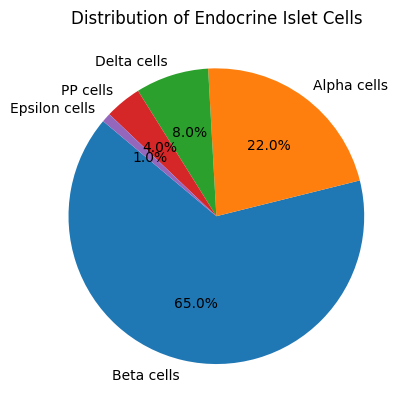
Endocrine islets are composed of clusters of polygonal cells arranged around a dense capillary network. This microvascular arrangement enables rapid sensing of circulating glucose levels and prompt hormone release. The islets exhibit cellular heterogeneity, consisting of five principal endocrine cell types.
3.2 Cellular Composition of Pancreatic Islets
Table 1. Major endocrine cell types of pancreatic islets and their functions

3.3 Beta Cells
Beta cells constitute the largest proportion of endocrine islet cells and are primarily located in the central region of the islets. They secrete insulin, which facilitates glucose uptake by peripheral tissues and suppresses hepatic glucose production. Loss or dysfunction of beta cells is a defining feature of diabetes mellitus.
3.4 Alpha Cells
Alpha cells are typically located at the periphery of the islets and secrete glucagon. This hormone acts antagonistically to insulin by increasing blood glucose levels during hypoglycemia through stimulation of glycogenolysis and gluconeogenesis in the liver.
3.5 Delta Cells
Delta cells secrete somatostatin, a hormone that inhibits the release of insulin and glucagon. Through local paracrine action, delta cells regulate the overall hormonal output of the islets and prevent excessive fluctuations in blood glucose levels.
3.6 Pancreatic Polypeptide and Epsilon Cells
Pancreatic polypeptide cells influence gastrointestinal motility, appetite, and pancreatic exocrine secretion. Epsilon cells, which secrete ghrelin, are relatively rare in adults but are more prominent during fetal development, suggesting a role in early metabolic regulation.
4. Discussion
The endocrine islets of the pancreas function as highly integrated micro-organs that regulate glucose homeostasis through coordinated hormone secretion. Beta cells dominate the islet population, reflecting the critical role of insulin in metabolic control. Alpha cells provide an essential counter-regulatory mechanism, ensuring adequate glucose availability during fasting states.
Delta cells play a modulatory role by inhibiting excessive hormone release, thereby stabilizing metabolic responses. The presence of pancreatic polypeptide and epsilon cells further emphasizes the integrative role of pancreatic endocrine tissue in linking metabolism with digestive and appetite-related processes.
Findings from this review are consistent with contemporary literature regarding islet cell proportions and functions. Minor variations in reported data may be attributed to differences in study methodology and population characteristics. Recent studies highlighting islet cell plasticity and intercellular communication suggest promising directions for regenerative therapies and diabetes management.
5. Conclusion
The endocrine islets of the pancreas consist of multiple specialized cell populations that collectively regulate glucose metabolism and energy balance. Each cell type contributes uniquely to hormonal control, and disruption of islet cell function leads to significant metabolic disease. A thorough understanding of endocrine islet cell biology is essential for advancing clinical management and therapeutic innovation in endocrine disorders
6. Suggestions and Recommendations
Early identification of islet cell dysfunction should be emphasized in individuals at risk of metabolic disease. Future research should focus on preserving or restoring beta cell mass through regenerative and transplantation-based approaches. Advances in molecular and imaging technologies may further improve understanding of islet cell interactions. Policy initiatives should prioritize funding for endocrine research and diabetes prevention programs.
References
1. Xavier GDS, et al.
The cells of the islets of Langerhans. J Clin Med. 2018.
👉https://www.ncbi.nlm.nih.gov/pmc/articles/PMC5867580/
2. Arrojo e Drigo R, et al.
New insights into the architecture of the islet of Langerhans. Diabetologia. 2015.
👉https://link.springer.com/article/10.1007/s00125-015-3699-0
3. Cabrera O, et al.
The unique cytoarchitecture of human pancreatic islets. PNAS. 2016.
👉 https://www.ncbi.nlm.nih.gov/pmc/articles/PMC5127382/
4. Brissova M, et al.
Assessment of human pancreatic islet architecture and composition. Diabetes. 2015.
👉https://diabetesjournals.org/diabetes/article/64/10/3451/35375
5. Stožer A, et al.
From Isles of Königsberg to Islets of Langerhans. Front Endocrinol. 2022.
👉https://www.frontiersin.org/articles/10.3389/fendo.2022.922640/full
6. Sakata N, et al.
Development and characteristics of pancreatic epsilon cells. Int J Mol Sci. 2019.
https://www.mdpi.com/1422-0067/20/8/1867
7. Mescher AL.
Junqueira’s Basic Histology – Pancreas Chapter. McGraw-Hill.