
Investigate burnout, psychosocial hazards, violence against workers, harassment and strategies for resilience
1. Dr.Turusbekova Akshoola Kozmanbetovna
2. Sohil Ali
(Teacher, International Medical Faculty, Osh State university, Kyrgyzstan
Student, International medical faculty, Osh State university, Kyrgyzstan)
Abstract:
The contemporary landscape of occupational health and safety (OHS) is undergoing a paradigm shift, moving from a focus on physical mechanics to a holistic management of psychological, social, and biological hazards. This report provides an expert-level synthesis of modern OHS strategies, investigating the structural drivers of burnout, evidence-based methodologies for psychosocial risk assessment, and systemic interventions for workplace violence and harassment. It further examines biological hazard protocols for tuberculosis, hepatitis, and COVID-19. By integrating standard-driven frameworks like ISO 45003 with emerging technologies such as predictive analytics and the cultivation of Psychological Capital (PsyCap), this analysis outlines a comprehensive program design for organizational resilience and worker protection.
Keywords: Psychosocial Hazards, Burnout, Workplace Violence, Occupational Infections, Resilience, ISO 45003, Psychological Capital (PsyCap), Risk Assessment.
The contemporary landscape of occupational health and safety (OHS) has transitioned toward a sophisticated understanding of the worker as a psychological, social, and biological entity. Work-related psychosocial hazards are on the verge of surpassing conventional occupational risks in their contribution to ill-health, disability, and national economic costs.1 In an era characterized by rapid industrialization and global health crises, the integration of mental health, violence prevention, and infectious disease control within a singular OHS management framework is a foundational legal and operational necessity.2
The Modern Taxonomy of Psychosocial Hazards and Burnout
Psychosocial hazards are elements of work design, organization, and management that have the potential to cause psychological or physical harm.1 Exposure to negative psychosocial factors has increased due to unfavorable changes in work organization, including the rise of Taylorist management styles characterized by rigid hierarchies and limited worker autonomy.5
Structural Predictors of Burnout and Occupational Stress
Burnout emerges from a fundamental mismatch between organizational requirements and worker resources.6 The Maslach Burnout Inventory (MBI) remains the gold standard for analysis, identifying three subscales: emotional exhaustion, depersonalization (cynicism), and reduced professional accomplishment.6 Research indicates that burnout disproportionately affects women and early-career professionals.6
The progression of burnout follows an eight-stage trajectory, beginning with hyperactivity—where workers put in excessive effort to address mounting demands—followed by profound exhaustion and eventual disengagement.6 As the syndrome intensifies, emotional reactions like anxiety emerge, culminating in cognitive breakdowns, social isolation, and psychosomatic symptoms like insomnia or chronic headaches.6 Notably, the "depersonalization" subscale is a stronger predictor of suicidal ideation than clinical depression alone.6
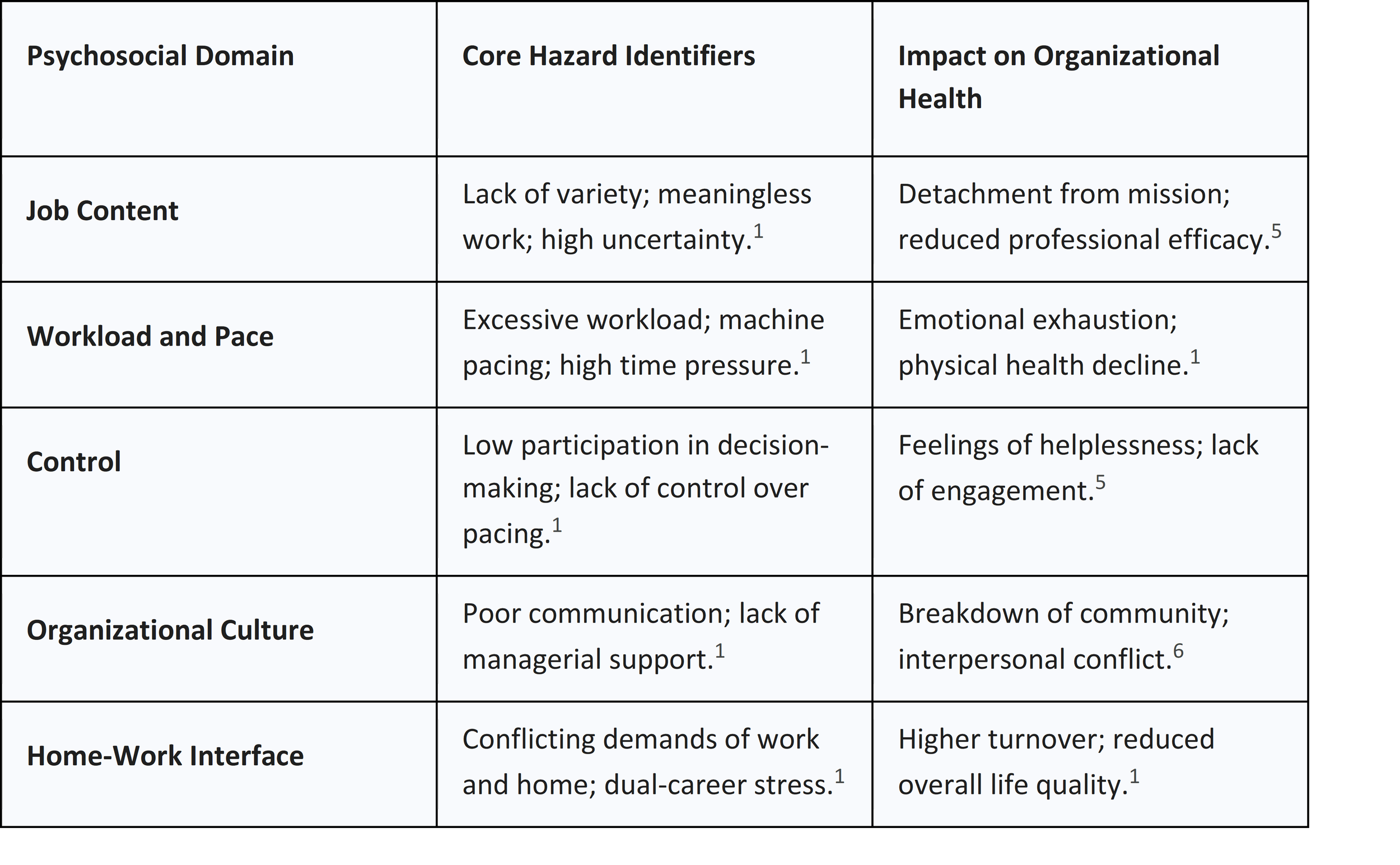
Environmental hazards such as extreme heat and air pollution are also significant predictors of burnout for field-based professionals.9 For these workers, high physical hazard exposure (beta = 0.76, p < 0.01) and extended work hours (over 10 hours per day, which increases risk by 40%) create a cumulative stress burden.9
Advanced Methodologies in Psychosocial Risk Assessment
Managing psychosocial risks with the same rigor as physical hazards is formalized in global standards such as ISO 45003 and emerging national legislation.10
Comparative Frameworks: ISO 45003, COPSOQ, and National Codes
ISO 45003:2021 provides international guidance on managing psychological health and safety, aligning with the Plan-Do-Check-Act cycle of ISO 45001.8 National frameworks, such as the SafeWork Australia Model Code of Practice, focus on operational risk management principles: identification, assessment, control, and review.12
The Copenhagen Psychosocial Questionnaire (COPSOQ) serves as a theory-independent tool for evidence-based assessment, covering a vast diversity of dimensions across different industries.14 Validation studies have demonstrated that COPSOQ "context" scales, such as job security and social support, are powerful predictors of "outcome" scales like general health and job satisfaction.14
The Role of Predictive Analytics and AI in Risk Mitigation
Artificial Intelligence (AI) and Machine Learning (ML) can now forecast burnout and hazard exposure with high precision.9
● XGBoost and Random Forest Models: These algorithms have achieved accuracy rates of 90% and 88%, respectively, in predicting workplace hazards.9
● LSTM Networks: Long Short-Term Memory networks forecast burnout trends using historical stress data with an 87% accuracy rate.9
● Weighted Composite Risk Scoring: Advanced algorithms integrate factors such as severity (S), frequency of exposure (F), number of exposed individuals (N), and organizational response capacity (R) to prioritize resource allocation.17
The integrated risk score is calculated as: Risk Score = S * F * N * (1 + R), where R is rated on a scale from -2 (excellent capacity) to +2 (deficient capacity).17
Violence Against Workers: Systemic Drivers and Interventions
Workplace violence (WPV) is an escalating occupational hazard, particularly within healthcare and retail.18 In healthcare, the COVID-19 pandemic catalyzed an increase in violent incidents due to staffing shortages and systemic burnout.19
Sector-Specific Risk Analysis
Violence is categorized by the relationship between the perpetrator and worker. Type II violence (patient/client-on-worker) is the most prevalent form in healthcare.18 Statistics show that healthcare workers have a 20% higher rate of workplace violence than the general workforce.18
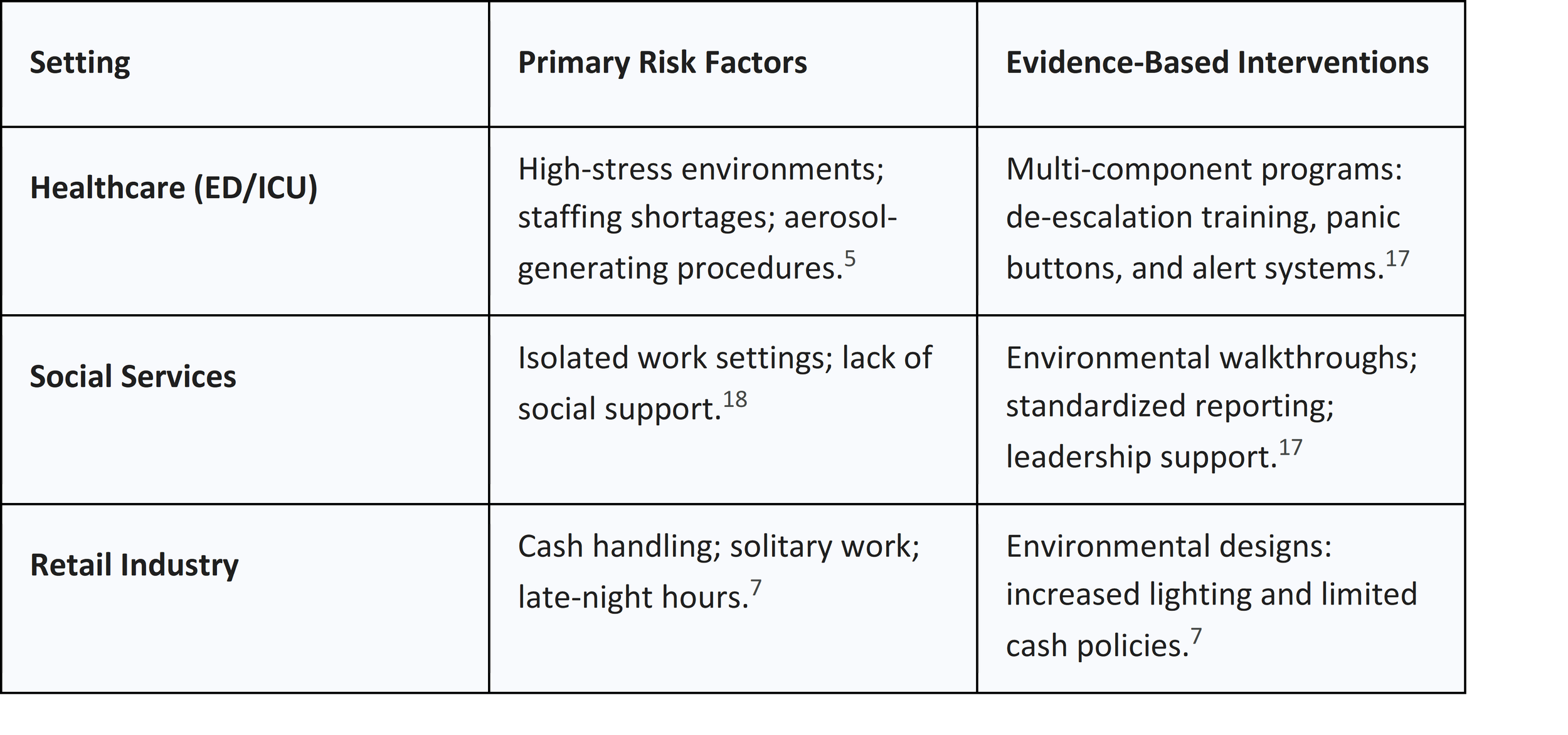
Critical appraisal indicates that standalone de-escalation training is often insufficient.17 The most effective strategy is a "multicomponent" approach integrating environmental modifications (security locks), administrative changes (zero-tolerance policies), and behavioral training.17
Harassment and Workplace Toxicity: A Critical Appraisal
Workplace harassment remains pervasive, leading to severe consequences such as depression and PTSD.22
The Failure of Traditional Training Paradigms
Traditional "check-the-box" training often fails to lead to long-term behavioral change because it focuses too narrowly on legal definitions to minimize liability.23 Research indicates that "masculinity culture"—environments where men feel they must prove their masculinity—is a significant predictor of harassment.26
Evidence-Based Prevention Strategies
To be effective, harassment prevention must be integrated into the organizational climate.23 Key design considerations include:
● Interactive Training: Active learning methods like role-playing increase knowledge retention by 50%.28
● Bystander Intervention: Training employees to intervene shifts responsibility from the victim to the collective.16
● Distributed Practice: Shorter, frequent "refresher" sessions combat the "forgetting curve".28
● The 25% Threshold: Organizational change can be achieved once 25% of the population advocates for a cultural shift.28
Psychological Capital and Strategies for Resilience
Resilience is a proactive capacity to maintain functioning amidst stress.29
The HERO Model of Psychological Capital (PsyCap)
Psychological Capital (PsyCap) is represented by the HERO acronym: Hope, Efficacy, Resilience, and Optimism.32
1. Hope: A motivational state based on planning and energy to meet goals.32
2. Efficacy: Confidence in one's ability to mobilize cognitive resources for a task.32
3. Resilience: The capacity to recover from adversity and progress beyond the previous state.35
4. Optimism: An attribution style viewing setbacks as temporary and specific.33
PsyCap is "state-like" and can be developed through intervention.32 Workers with higher PsyCap are more engaged and less likely to suffer from burnout.32
Occupational Infections: TB, Hepatitis, and COVID-19
Biological hazards require rigorous adherence to the hierarchy of controls: elimination, engineering, administrative, and PPE.37
Tuberculosis (TB) Control Protocols
Protecting workers from TB requires a written exposure control plan and environmental controls.38
● Screening: New employees should undergo baseline testing (Mantoux skin test or IGRA blood test).25
● Post-Exposure: If exposed without a respirator, immediate testing followed by repeat testing at 8–10 weeks is mandatory.39
● Ventilation: Suspected cases must be isolated in Airborne Infection Isolation Rooms (AIIRs) maintaining negative pressure.25
Hepatitis B and C Management
Hepatitis B (HBV) and C (HCV) are the most common bloodborne pathogen risks after sharps injuries.20
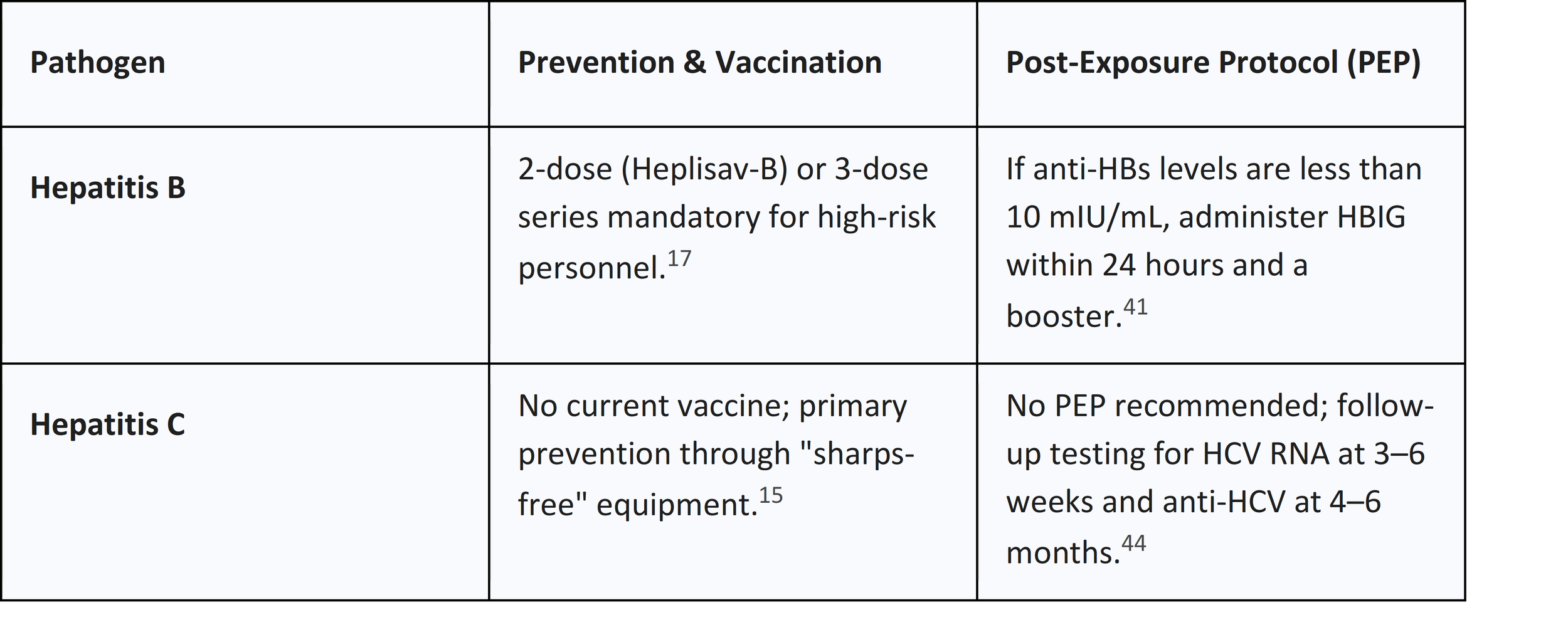
For HCV, the "test and treat" approach is the standard, as Direct-Acting Antiviral (DAA) therapies have cure rates exceeding 95%.45
COVID-19 and Respiratory Etiquette
The COVID-19 pandemic redefined standard precautions to include universal masking and N95 respirators for aerosol-generating procedures.5 Environmental cleaning protocols use sodium hypochlorite at 500 ppm for general surfaces and 1000 ppm for surfaces contaminated with bodily fluids.48
Prevention Program Design and the Integrated Approach
The ultimate goal of OHS management is the design of comprehensive programs that protect and promote worker health.49
The Integrated Approach Triad
A mentally healthy workplace operates through three domains 51:
1. Prevent Harm: Reducing psychosocial hazards through work design and organizational change.51
2. Promote the Positive: Strengthening PsyCap and fostering a psychologically safe climate.52
3. Respond to Problems: Providing EAPs, Mental Health First Aid, and return-to-work protocols.54
The Knowledge to Action (KTA) framework identifies 109 instruments—such as the FlourishDX suite and Guarding Minds at Work—to assist organizations in auditing services and monitoring effectiveness.51
Conclusions and Strategic Outlook
The future of occupational health lies in the seamless integration of physical, psychological, and biological risk management. True resilience is built upon organizational justice, leadership commitment, and the systematic development of psychological capital.6 By treating psychosocial and biological hazards with the same scientific rigor as traditional risks, employers can create environments where workers actively flourish.37
References -
1. An urgent call to address work-related psychosocial hazards and ..., accessed January 12, 2026, https://pmc.ncbi.nlm.nih.gov/articles/PMC11980372/
2. Psychosocial risks and mental health at work, accessed January 12, 2026, https://osha.europa.eu/en/themes/psychosocial-risks-and-mental-health
3. (PDF) Occupational Disease Prevention Strategies through OHS Interventions: Global Evaluation and Challenges - ResearchGate, accessed January 12, 2026, https://www.researchgate.net/publication/391473458_Occupational_Disease_Prevention_Strategies_through_OHS_Interventions_Global_Evaluation_and_Challenges
4. Integrating Occupational Health and Safety into Enterprise Risk Management: a structural evaluation - Frontiers, accessed January 12, 2026, https://www.frontiersin.org/journals/public-health/articles/10.3389/fpubh.2025.1608227/full
5. Psychosocial factors at work and their impact on health: contributions to current debates, accessed January 12, 2026, https://pmc.ncbi.nlm.nih.gov/articles/PMC12377845/
6. Job Burnout: Consequences for Individuals, Organizations, and Equity - NCBI, accessed January 12, 2026, https://www.ncbi.nlm.nih.gov/books/NBK614516/
7. Workplace violence intervention effectiveness - CDC Stacks, accessed January 12, 2026, https://stacks.cdc.gov/view/cdc/187437/cdc_187437_DS1.pdf
8. Psychosocial Hazards Based on ISO 45003 - NASP, accessed January 12, 2026, https://www.naspweb.com/blog/psychosocial-hazards/
9. Predicting Workplace Hazard, Stress and Burnout Among Public Health Inspectors: An AI-Driven Analysis in the Context of Climate Change - PMC - PubMed Central, accessed January 12, 2026, https://pmc.ncbi.nlm.nih.gov/articles/PMC12109726/
10. Managing Psychosocial Hazards: Balancing Well-being with Physical Safety - Riskonnect, accessed January 12, 2026, https://riskonnect.com/governance-risk-compliance/managing-psychosocial-hazards-balancing-well-being/
11. Guidance for TB Screening, Testing and Treatment of Health Care ..., accessed January 12, 2026, https://ctca.org/wp-content/uploads/GHCPS02_14_2025.pdf
12. ISO 45003 vs Code of Practice: Psychosocial Hazards at Work - FEFO Consulting, accessed January 12, 2026, https://fefo.com.au/iso-45003-vs-code-of-practice-psychosocial-hazards-at-work/
13. Full article: Emotional intelligence and psychological capital at work: a systematic literature review and directions for future research, accessed January 12, 2026, https://www.tandfonline.com/doi/full/10.1080/23311886.2024.2443559
14. A Validation Study of the COPSOQ III Greek Questionnaire for Assessing Psychosocial Factors in the Workplace - PMC - NIH, accessed January 12, 2026, https://pmc.ncbi.nlm.nih.gov/articles/PMC12385713/
15. Preliminary Validation of the Portuguese Short Version of the Copenhagen Psychosocial Questionnaire III - COPSOQ network, accessed January 12, 2026, https://www.copsoq-network.org/assets/pdf/2024/Validation_Portugal_Pinto_Sustainability_2024.pdf
16. Systematic Review of Policies and Interventions to Prevent Sexual Harassment in the Workplace in Order to Prevent Depression - PubMed Central, accessed January 12, 2026, https://pmc.ncbi.nlm.nih.gov/articles/PMC9603480/
17. A Risk Management Approach in Occupational Health and Safety Based on the Integration of a Weighted Composite Score - MDPI, accessed January 12, 2026, https://www.mdpi.com/2313-576X/11/4/103
18. Guidelines for Preventing Workplace Violence for Healthcare and Social Service Workers - OSHA, accessed January 12, 2026, https://www.osha.gov/sites/default/files/publications/osha3148.pdf
19. Addressing Workplace Violence and Creating a Safer Workplace | PSNet, accessed January 12, 2026, https://psnet.ahrq.gov/perspective/addressing-workplace-violence-and-creating-safer-workplace
20. Bloodborne Infectious Disease Risk Factors | Healthcare Workers - CDC, accessed January 12, 2026, https://www.cdc.gov/niosh/healthcare/risk-factors/bloodborne-infectious-diseases.html
21. A Systematic Review: Effectiveness of Interventions to De-escalate ..., accessed January 12, 2026, https://pmc.ncbi.nlm.nih.gov/articles/PMC8430427/
22. Education and training interventions for healthcare workers to ..., accessed January 12, 2026, https://pmc.ncbi.nlm.nih.gov/articles/PMC11800325/
23. The Effectiveness of Workplace Sexual Harassment Prevention Training: A Systematic Review - ResearchGate, accessed January 12, 2026, https://www.researchgate.net/publication/390246952_The_Effectiveness_of_Workplace_Sexual_Harassment_Prevention_Training_A_Systematic_Review
24. Does Workplace Sexual Harassment Training Really Work? Evolving Best Practices for EAPs, accessed January 12, 2026, https://archive.hshsl.umaryland.edu/bitstreams/724fade4-7a30-46f5-a547-71fd07ade58a/download
25. Tuberculosis: Steps to Protect Workers, accessed January 12, 2026, https://www.aft.org/sites/default/files/media/documents/2025/steps_to_protect_pe_k-12_he_workers_from_tb.pdf
26. 2 Setting the Stage: Evaluating Efforts to Prevent and Address Sexual Harassment, accessed January 12, 2026, https://www.nationalacademies.org/read/26279/chapter/3
27. Post-exposure Prophylaxis : What Every Health Care Worker Should Know - PMC - NIH, accessed January 12, 2026, https://pmc.ncbi.nlm.nih.gov/articles/PMC4921572/
28. Evidence-based recommendations for improved design of sexual harassment training | Industrial and Organizational Psychology | Cambridge Core, accessed January 12, 2026, https://www.cambridge.org/core/journals/industrial-and-organizational-psychology/article/evidencebased-recommendations-for-improved-design-of-sexual-harassment-training/10A30EF219E4A459E940A7FAAD88AEB8
29. Full article: Adopting an Evidence-Based Proactive Resilience Approach to Social Work Practice - Taylor & Francis Online, accessed January 12, 2026, https://www.tandfonline.com/doi/full/10.1080/26408066.2025.2480399
30. The Power of Psychological Capital: A Comprehensive Review of Data on Resilience, Hope, Optimism, and Efficacy - African Journal of Biomedical Research, accessed January 12, 2026, https://africanjournalofbiomedicalresearch.com/index.php/AJBR/article/download/1325/1572/3078
31. Tuberculosis - Standards | Occupational Safety and Health Administration - OSHA, accessed January 12, 2026, https://www.osha.gov/tuberculosis/standards
32. The Role of Psychological Capital and Work Engagement in Enhancing Construction Workers' Safety Behavior - Frontiers, accessed January 12, 2026, https://www.frontiersin.org/journals/public-health/articles/10.3389/fpubh.2022.810145/full
33. The Power of Psychological Capital: A Comprehensive Review of Data on Resilience, Hope, Optimism, and Efficacy - ResearchGate, accessed January 12, 2026, https://www.researchgate.net/publication/389857346_The_Power_of_Psychological_Capital_A_Comprehensive_Review_of_Data_on_Resilience_Hope_Optimism_and_Efficacy
34. Experts needed: international study on work-related psychosocial risks legislation, accessed January 12, 2026, https://osha.europa.eu/en/oshnews/experts-needed-international-study-work-related-psychosocial-risks-legislation
35. Personal resilience and coping with implications for work. Part I: A review - ResearchGate, accessed January 12, 2026, https://www.researchgate.net/publication/303593443_Personal_resilience_and_coping_with_implications_for_work_Part_I_A_review
36. Psychological Resources and Strategies to Cope with Stress at Work - PubMed Central, accessed January 12, 2026, https://pmc.ncbi.nlm.nih.gov/articles/PMC7110156/
37. Understanding OHS: A holistic approach to employee health and safety - Calian, accessed January 12, 2026, https://www.calian.com/health/blogs/understanding-ohs-a-holistic-approach-to-employee-health-and-safety/
38. Infectious Agents Risk Factors | Healthcare Workers - CDC, accessed January 12, 2026, https://www.cdc.gov/niosh/healthcare/risk-factors/infectious-agents.html
39. Nurse Management of Occupational TB Exposures - Mayo Clinic Center for Tuberculosis, accessed January 12, 2026, https://centerfortuberculosis.mayo.edu/media/studio-sites/center-for-tuberculosis-website/education-and-training/tb-nursing-symposium/From-Exposure-to-Action-Nurse-Management-of-Occupational-TB-Exposures.pdf
40. Transmission-Based Precautions | Infection Control - CDC, accessed January 12, 2026, https://www.cdc.gov/infection-control/hcp/basics/transmission-based-precautions.html
41. Hepatitis B and Healthcare Personnel - Immunize.org, accessed January 12, 2026, https://www.immunize.org/wp-content/uploads/catg.d/p2109.pdf
42. Hepatitis B Vaccine Administration - CDC, accessed January 12, 2026, https://www.cdc.gov/hepatitis-b/hcp/vaccine-administration/index.html
43. Clinical Care of Hepatitis B - CDC, accessed January 12, 2026, https://www.cdc.gov/hepatitis-b/hcp/clinical-care/index.html
44. Guidelines for Health Care Personnel Exposed to Hepatitis C Virus - CDC, accessed January 12, 2026, https://www.cdc.gov/hepatitis-c/hcp/infection-control/index.html
45. Management of Health Care Personnel Exposed to HCV | Hepatitis C Online, accessed January 12, 2026, https://www.hepatitisc.uw.edu/pdf/key-populations-situations/management-health-care-workers-potentially-exposed-to-hcv/core-concept/all
46. CDC issues guidance on exposure to HCV for health professionals, accessed January 12, 2026, https://www.pharmacist.com/Blogs/CEO-Blog/Article/cdc-issues-guidance-on-exposure-to-hcv-for-health-professionals
47. COVID-19 - Control and Prevention - Healthcare Workers and Employers | Occupational Safety and Health Administration - OSHA, accessed January 12, 2026, https://www.osha.gov/coronavirus/control-prevention/healthcare-workers
48. Infection Control - BC Centre for Disease Control, accessed January 12, 2026, https://www.bccdc.ca/health-professionals/clinical-resources/covid-19-care/infection-control
49. How to Create an Effective Mental Health Wellness Program | Devine Interventions, accessed January 12, 2026, https://dinterventions.com/how-to-create-an-effective-mental-health-wellness-program/
50. workplace violence - OPM, accessed January 12, 2026, https://www.opm.gov/policy-data-oversight/worklife/reference-materials/workplaceviolence.pdf
51. An Integrated Approach to Workplace Mental Health: A Scoping ..., accessed January 12, 2026, https://pmc.ncbi.nlm.nih.gov/articles/PMC9859114/
52. A mentally healthy framework to guide employers and policy makers - PMC, accessed January 12, 2026, https://pmc.ncbi.nlm.nih.gov/articles/PMC11301648/
53. Cross-Sectional Study of Resilience, Positivity and Coping Strategies as Predictors of Engagement-Burnout in Undergraduate Students: Implications for Prevention and Treatment in Mental Well-Being - PMC - NIH, accessed January 12, 2026, https://pmc.ncbi.nlm.nih.gov/articles/PMC7928383/
54. How to design a workplace wellness program that works - Plus One, an Optum Company, accessed January 12, 2026, https://www.plusoneworkplacewellbeing.com/how-to-design-a-workplace-wellness-program-that-works/