
Symptomology and General Principles of Treatment of Chronic Glomerulonephritis
1. Kebekova Aizat Ashimzhanovna
2. Arul Agastinal Kubin Berth
3. Murugan Sri Mandhagini
4. Sridhar Sujitha
(1. Lecturer, International Medical Faculty, Osh State University, Osh, Kyrgyz Republic
2. Student, International Medical Faculty, Osh State University, Osh, Kyrgyz Republic
3. Student, International Medical Faculty, Osh State University, Osh, Kyrgyz Republic
4. Student, International Medical Faculty, Osh State University, Osh, Kyrgyz Republic)
Abstract
Chronic glomerulonephritis (CGN) is not a single disease but a final common pathway of diverse immune-mediated injuries to the glomerulus, collectively responsible for a substantial proportion of end-stage kidney disease worldwide. Its clinical presentation is notoriously protean — many patients remain asymptomatic for years, discovered only through incidental microscopic hematuria or proteinuria, while others present with nephritic syndrome, nephrotic syndrome, or insidiously progressive chronic kidney disease (CKD). The last five years have transformed the therapeutic landscape of this field more profoundly than the preceding five decades. Supportive care has been redefined by sodium-glucose cotransporter-2 (SGLT2) inhibitors, which are now a pillar of therapy for proteinuric chronic glomerulonephritis regardless of diabetes status; disease-specific therapy has been revolutionized by targeted-release budesonide, the dual endothelin–angiotensin receptor antagonist sparsentan, and complement inhibitors such as iptacopan and pegcetacoplan; and the KDIGO 2025 IgA nephropathy guideline has formalized a new paradigm of dual-track therapy — attacking both the upstream immunologic driver and the downstream consequences of nephron loss. This article reviews the symptomatology of chronic glomerulonephritis, its diagnostic evaluation, and the general and disease-specific principles of treatment as they stand in late 2025, with particular attention to the evidence base behind each therapeutic pillar. The central thesis is that chronic glomerulonephritis has evolved from a diagnosis of therapeutic resignation into one of active, layered intervention — but that this progress places a premium on early detection, since the new therapies preserve function far more readily than they restore it.
Keywords: chronic glomerulonephritis; IgA nephropathy; proteinuria; hematuria; SGLT2 inhibitors; complement inhibitors; immunosuppression; KDIGO
1. Introduction
Ask a medical student to describe chronic glomerulonephritis, and the answer will usually begin with the classical textbook triad of hematuria, proteinuria, and hypertension. Ask a nephrologist, and the answer will more likely begin with a warning: that the most dangerous version of this disease is the one that produces no symptoms at all. Chronic glomerulonephritis encompasses a family of histologically and etiologically distinct disorders — IgA nephropathy, focal segmental glomerulosclerosis, membranous nephropathy, membranoproliferative and C3 glomerulopathies, lupus nephritis, and the chronic evolution of post-infectious and vasculitic glomerulonephritides — united by progressive, immune-mediated damage to the glomerular filter. It remains one of the leading causes of end-stage kidney disease worldwide, and because the kidney suffers in silence, a large fraction of patients present only after irreversible nephron loss has occurred. The tragedy of chronic glomerulonephritis, historically, was the combination of late detection with late therapy: supportive care meant watching the creatinine rise, and immunosuppression meant corticosteroids and cytotoxics whose toxicity was sometimes as burdensome as the disease.
The therapeutic environment of 2025 is unrecognizably different. Three converging revolutions have reshaped the field. First, the sodium-glucose cotransporter-2 inhibitors, developed as antidiabetic agents, have demonstrated renal protection across proteinuric kidney diseases of nearly every etiology, and the DAPA-CKD and EMPA-KIDNEY trials have established them as foundational therapy in chronic glomerulonephritis (Sridhar and colleagues, reviewing the CKD prescribing evidence, note DAPA-CKD reduced the composite of sustained eGFR decline, end-stage kidney disease, and renal or cardiovascular death by 39%). Second, disease-specific targeted therapies have arrived in rapid succession: targeted-release budesonide (Nefecon) delivers corticosteroid directly to the ileal Peyer's patches where pathogenic IgA is generated; the dual endothelin–angiotensin receptor antagonist sparsentan achieved accelerated approval for IgA nephropathy in 2023; and 2025 alone brought FDA approval of two complement-targeted agents — the oral factor B inhibitor iptacopan in March and the C3/C3b inhibitor pegcetacoplan in July — representing the first disease-modifying therapies ever approved for C3 glomerulopathy. Third, the KDIGO 2025 guideline for IgA nephropathy, the most common form of primary chronic glomerulonephritis worldwide, has formalized a conceptual framework in which therapy simultaneously targets the production of pathogenic immune complexes and the consequences of established nephron loss, with stricter proteinuria goals than ever before — below 0.5 g/day, ideally below 0.3 g/day (KDIGO 2025 IgAN/IgAV Guideline Executive Summary).
This article addresses the symptomatology and general principles of treatment of chronic glomerulonephritis, with the emphasis deliberately placed where contemporary practice places it: on the layered strategy in which lifestyle and supportive measures, hemodynamic nephroprotection, disease-specific immunomodulation, and now complement and B-cell–directed therapy are combined according to the individual patient's histological diagnosis, proteinuria burden, and rate of functional decline.
2. Methods
This review was prepared through a structured survey of the current peer-reviewed literature and international guideline documents. PubMed, Scopus, and Google Scholar were searched through November 2025 using combinations of the terms "chronic glomerulonephritis," "IgA nephropathy," "membranous nephropathy," "C3 glomerulopathy," "lupus nephritis," "treatment," "KDIGO," "SGLT2 inhibitor," "sparsentan," "budesonide," "iptacopan," and "complement inhibitor." Particular weight was given to the KDIGO 2024 lupus nephritis guideline, the KDIGO 2025 IgA nephropathy/IgA vasculitis guideline and its executive summary, pivotal randomized controlled trials (DAPA-CKD, EMPA-KIDNEY, PROTECT, NefIgArd, APPEAR-C3G, VALIANT, TESTING, BLISS-LN), and regulatory announcements through late 2025. Foundational earlier studies were included where they defined the clinical syndromes or established the evidence base for immunosuppressive therapy. All synthesis, organization, and interpretation are original to this article; quantitative findings are attributed to their primary sources.
3. Results
3.1 Symptomatology: the clinical face of a silent disease
The symptomatology of chronic glomerulonephritis is best understood not as a single presentation but as a spectrum with four anchor points, between which patients drift over the course of years. At one pole lies the asymptomatic presentation, which is also the most common. Persistent microscopic hematuria — classically dysmorphic red cells and red cell casts on phase-contrast microscopy — together with sub-nephrotic proteinuria discovered on routine dipstick or urine albumin–creatinine ratio testing accounts for the majority of new diagnoses, particularly of IgA nephropathy. The KDIGO 2025 guideline now encourages a more liberal biopsy policy, with biopsy indicated for sustained proteinuria above 0.5 g/day rather than the older 1 g/day threshold, precisely because the asymptomatic or pauci-symptomatic phase is the therapeutic window. Many patients are identified only through school, employment, military, or insurance screening, or during evaluation for unrelated complaints; the frequency with which the disease is found "by accident" is one of its defining epidemiological features.
The classical nephritic syndrome — gross hematuria (often "cola-colored" or "smoky" urine), edema, hypertension, and oliguria — represents the second presentation and is more characteristic of acute or acutely relapsing disease superimposed on chronic injury. In IgA nephropathy, episodes of visible hematuria synpharyngitic with upper respiratory infection (appearing within 1–3 days, in contrast to the 2–3 week latency of post-streptococcal glomerulonephritis) remain a highly characteristic clue. The third presentation is nephrotic syndrome, with heavy proteinuria exceeding 3.5 g/day, hypoalbuminemia, edema, and hyperlipidemia, which dominates in membranous nephropathy, focal segmental glomerulosclerosis, and class V lupus nephritis. The fourth, and most ominous, is the insidious uremic presentation: the patient with long-unrecognized disease who presents with fatigue, nausea, anemia, nocturia, and pruritus of established advanced CKD. Between these poles lie the nonspecific constitutional complaints that populate real clinic notes — mild flank heaviness, foamy urine that the patient noticed months before mentioning, nocturnal polyuria, reduced exercise tolerance, and the gradually worsening hypertension that so often turns out to have been the first measurable sign.
Hypertension deserves particular emphasis because it is simultaneously a symptom, a complication, and an accelerating driver of glomerular injury. It develops through sodium retention, renin activation from ischemic nephrons, and increased sympathetic tone, and it both reflects and causes progression. Similarly, the edema of chronic glomerulonephritis is mechanistically instructive: in nephritic-pattern disease it reflects primary sodium retention and tends toward periorbital morning puffiness, while in nephrotic-pattern disease it reflects hypoalbuminemia with secondary sodium retention and tends toward dependent pitting edema, sometimes with ascites and pleural effusions. In advanced disease, the symptoms become those of chronic kidney failure: the anemia of erythropoietin deficiency, the pruritus and dysgeusia of uremic toxin retention, the bone pain and fractures of mineral-bone disorder, and the cognitive dulling that patients often recognize only in retrospect.
It is worth dwelling, for a moment, on what this symptomatology means at the bedside. The student should understand that the physical examination of a patient with chronic glomerulonephritis may be strikingly normal. Blood pressure measurement, urinalysis with microscopy, serum creatinine and eGFR, and urine protein quantification are the sensory organs with which the clinician "feels" a disease the patient cannot feel. This is why the 2025 paradigm of dynamic risk assessment — continuous re-evaluation of proteinuria and eGFR slope, with therapy escalation without waiting — represents such a conceptual advance: it codifies the recognition that in this disease, waiting for symptoms is waiting too long.
3.2 Diagnostic evaluation
Before treatment can be principled, diagnosis must be specific, because chronic glomerulonephritis is not treated as a generic entity but according to its histological and increasingly its molecular identity. The evaluation proceeds in layers. Urinalysis with sediment examination establishes the glomerular nature of injury (dysmorphic erythrocytes, acanthocytes, red cell casts), and proteinuria is quantified by spot urine protein– or albumin–creatinine ratio, with 24-hour collection reserved for discrepant or borderline results. Blood work defines function (creatinine, eGFR, urea), consequences (albumin, cholesterol, hemoglobin), and etiology: complement levels C3 and C4, antinuclear antibody and anti-dsDNA, ANCA, anti-GBM antibody, hepatitis B and C and HIV serology, serum and urine protein electrophoresis with free light chains in adults over forty, anti-PLA2R antibody for suspected membranous nephropathy, and ASO/anti-DNase B titers where post-streptococcal disease is considered. Kidney ultrasound confirms size and symmetry — small, echogenic, shrunken kidneys signal irreversible chronicity and may render biopsy hazardous. Kidney biopsy remains the diagnostic gold standard, and current guidance explicitly encourages performing it earlier and more liberally, because treatment decisions increasingly depend on the activity-versus-chronicity balance that only histology can provide (KDIGO 2025). Risk stratification tools such as the International IgAN Prediction Tool, now validated for both adults and children, integrate clinical and histological variables to estimate progression risk and guide the intensity of therapy.
3.3 General principles of treatment I: lifestyle and supportive care
All treatment of chronic glomerulonephritis, regardless of histological subtype, rests on a common foundation, and the evidence for this foundation has strengthened rather than weakened as specific therapies have multiplied. Dietary sodium restriction to below approximately 2 g of sodium (5 g of salt) daily potentiates the antiproteinuric effect of renin–angiotensin blockade and remains among the most cost-effective interventions in nephrology. Smoking cessation is mandatory; tobacco accelerates GFR decline and adds cardiovascular risk to a population already carrying excess cardiovascular mortality. Weight management, regular aerobic exercise, moderation of dietary protein (approximately 0.8 g/kg/day in non-nephrotic patients, individualized to avoid malnutrition), and correction of metabolic acidosis with oral alkali or dietary base all contribute measurably to slowing progression. Vaccination — influenza, pneumococcal, hepatitis B, and meningococcal vaccination where complement inhibition is planned — is an unglamorous but essential element, particularly in patients destined for immunosuppression. The cardiovascular risk of CKD must be treated as actively as the kidney disease itself: statin therapy is recommended in non-dialysis CKD patients, a recommendation reinforced by the 2025 VA/DoD CKD clinical practice guideline.
3.4 General principles of treatment II: hemodynamic nephroprotection
The second pillar is pharmacological reduction of intraglomerular pressure, and here the last five years have rewritten the standard. Renin–angiotensin system blockade with an ACE inhibitor or angiotensin receptor blocker, titrated to the maximally tolerated dose, remains the cornerstone for every patient with proteinuric glomerular disease; blood pressure targets have tightened, with the KDIGO 2025 IgAN guideline recommending a systolic target below 120 mmHg. The transformative addition is the SGLT2 inhibitor class. DAPA-CKD demonstrated that dapagliflozin reduced the composite kidney endpoint by 39% with a number needed to treat of 19, with consistent benefit in patients with and without diabetes; the trial specifically enrolled patients with IgA nephropathy and FSGS, and EMPA-KIDNEY extended the benefit to CKD populations with lower albuminuria. SGLT2 inhibitors are now recommended as a component of conservative care for proteinuric chronic glomerulonephritis regardless of diabetes status, generally at eGFR above 20–25 ml/min/1.73 m² and continuable until dialysis. Two cautions accompany them: a modest acute eGFR dip on initiation is expected and benign, and patients on immunosuppression were excluded from the pivotal trials, so vigilance for genitourinary infection is warranted when the two are combined — though critically, SGLT2 inhibitors should never be used instead of indicated immunosuppression. To this duo has been added, in proteinuric IgA nephropathy, the dual endothelin–angiotensin receptor antagonist sparsentan, which the PROTECT trial showed superior to irbesartan alone in proteinuria reduction, and the selective endothelin antagonist atrasentan; fluid retention is the characteristic adverse effect of endothelin blockade, and real-world data suggest combination with an SGLT2 inhibitor both mitigates edema and enhances the antiproteinuric effect. For diabetic and proteinuric CKD, the nonsteroidal mineralocorticoid receptor antagonist finerenone adds a further layer of anti-inflammatory and antifibrotic protection.
3.5 General principles of treatment III: immunosuppression and disease-specific therapy
The third pillar targets the underlying immunopathogenesis, and its application must be individualized with genuine care, because the cardinal error of past decades was the indiscriminate use of toxic immunosuppression in patients whose disease was either too mild to warrant it or too chronically scarred to respond. The contemporary approach is best illustrated disease by disease.
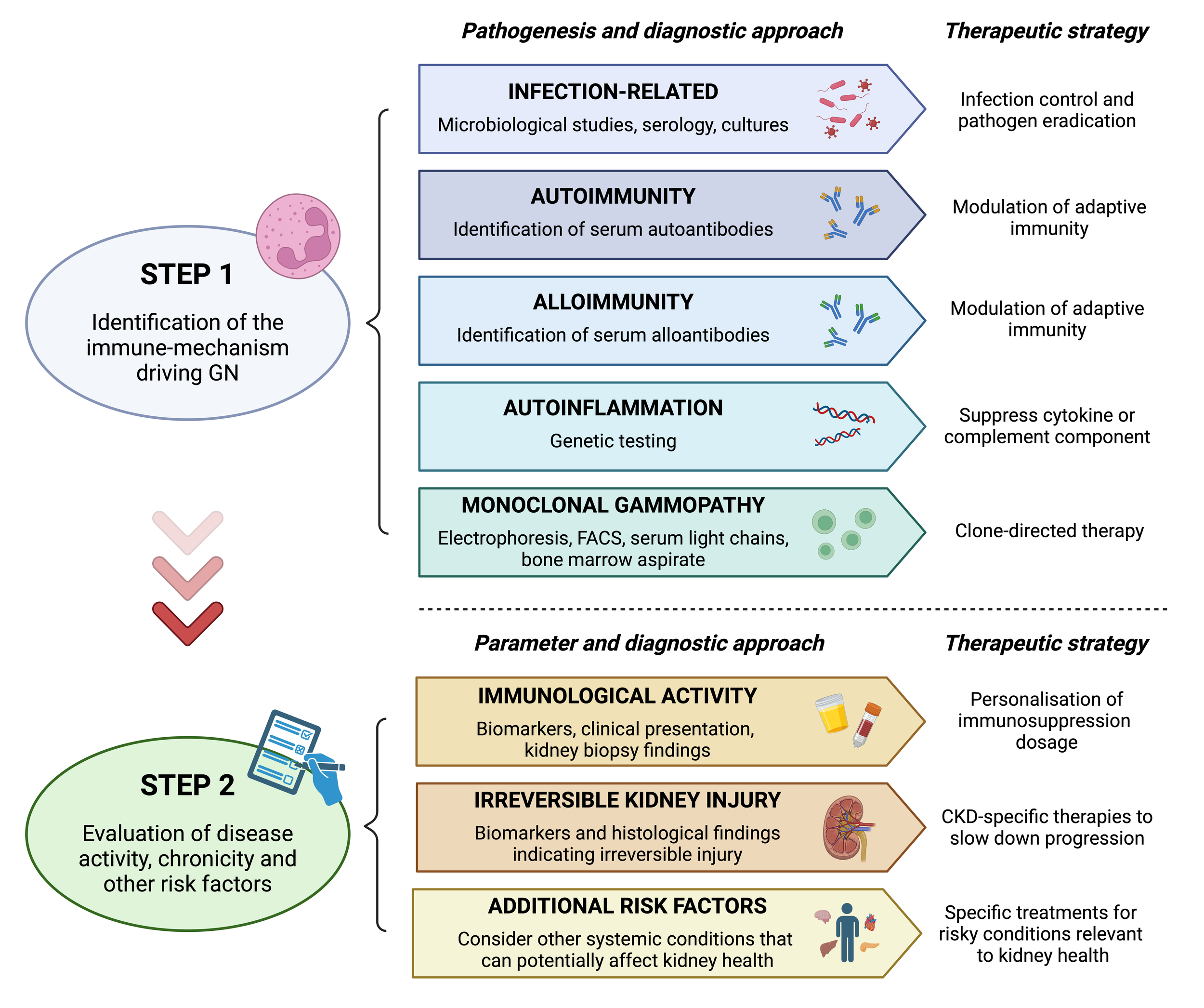
In IgA nephropathy, the most common primary chronic glomerulonephritis, the KDIGO 2025 guideline has crystallized the dual-track concept: therapies that prevent or reduce formation of pathogenic IgA and IgA-containing immune complexes, layered on therapies that manage the consequences of established nephron loss. The latter is the supportive armamentarium described above. The former now begins with targeted-release budesonide (Nefecon), a 9-month course recommended as first-line disease-specific therapy for at-risk patients; where unavailable, reduced-dose systemic corticosteroids (approximately 0.4 mg/kg/day of methylprednisolone with taper, as validated in the low-dose TESTING regimen, with antimicrobial prophylaxis) replace the historically toxic high-dose protocols. In Chinese patients, mycophenolate mofetil has supportive evidence as a steroid-sparing agent. The proteinuria goal has been redefined downward — below 0.5 g/day and ideally below 0.3 g/day — because observational data have dismantled the old assumption that proteinuria under 1 g/day is benign. Beyond these approved agents, the pipeline is remarkably rich: the oral factor B inhibitor iptacopan reduced proteinuria in the APPLAUSE-IgAN interim analysis and received accelerated FDA approval; the C5 inhibitor ravulizumab reduced proteinuria by approximately 30% in the phase 2 SANCTUARY trial; and APRIL/BAFF-directed biologics (sibeprenlimab, atacicept, povetacicept, zigakibart) and anti-CD38 antibodies (felzartamab, mezagitamab) are in advanced development, promising true upstream interruption of pathogenic IgA production.
In lupus nephritis, the KDIGO 2024 guideline recommends initial therapy for active class III/IV disease with glucocorticoids plus mycophenolate or low-dose intravenous cyclophosphamide, with triple therapy incorporating belimumab (validated in the BLISS-LN trial) or a calcineurin inhibitor such as voclosporin for appropriate patients; maintenance relies on mycophenolate, with azathioprine as the alternative when pregnancy is contemplated. The 2025 NOBILITY follow-on REGENCY trial of obinutuzumab, a glycoengineered anti-CD20 antibody, demonstrated superior complete renal response and has added potent B-cell depletion to the proliferative lupus nephritis armamentarium (Furie et al., NEJM 2025).
In primary membranous nephropathy, risk stratification by anti-PLA2R antibody titer and proteinuria guides therapy; rituximab has become first-line for many patients following the MENTOR trial's demonstration of its superiority over cyclosporine in maintaining remission, with cyclophosphamide-based regimens (Ponticelli) reserved for high-risk disease, and obinutuzumab emerging for rituximab-refractory cases. In C3 glomerulopathy and immune-complex MPGN, 2025 was the watershed year: iptacopan (approved March 2025 on the APPEAR-C3G phase 3 data) and pegcetacoplan (approved July 2025 on the VALIANT data) became the first disease-modifying therapies for a condition in which recurrence after transplantation exceeds 60% and conventional immunosuppression had largely failed. In ANCA-associated vasculitis, the C5a receptor antagonist avacopan has permitted steroid-sparing regimens alongside rituximab or cyclophosphamide induction.
3.6 Special situations and the longitudinal view
Several cross-cutting principles deserve explicit statement. Pregnancy requires preconception planning: ACE inhibitors, ARBs, SGLT2 inhibitors, sparsentan, and targeted-release budesonide should be stopped before conception, with pregnancy-compatible antihypertensives substituted and glucocorticoids used if immunosuppression is unavoidable. Rapidly progressive glomerulonephritis — the crescentic transformation of any chronic form — remains a medical emergency requiring pulse corticosteroids and, according to etiology, cyclophosphamide, rituximab, or plasma exchange. Children follow parallel but distinct pathways (the IPNA 2025 guideline for pediatric IgAN), and the elderly require particular attention to infection risk and drug accumulation. Finally, monitoring is itself a treatment principle: proteinuria, eGFR slope, blood pressure, and disease-specific serologies (anti-PLA2R titer, complement levels, anti-dsDNA) are followed longitudinally, with relapse surveillance continuing even after remission, because chronic glomerulonephritis is, above all, a disease of decades rather than months.
4. Discussion
Taken together, the evidence assembled here supports a genuinely optimistic re-reading of what was once among the most pessimistic diagnoses in internal medicine. The historical arc is instructive: from the pre-steroid era, in which chronic glomerulonephritis was a sentence of progressive uremia; through the cytotoxic era, in which toxicity tempered efficacy; to the current era, in which a patient diagnosed with IgA nephropathy in 2025 may reasonably be offered sodium restriction, an ACE inhibitor titrated to maximum dose, an SGLT2 inhibitor, targeted-release budesonide, and — if proteinuria persists — sparsentan, a complement inhibitor, or enrolment in one of a dozen active biologic trials. Yet this progress carries an uncomfortable corollary: nearly every new therapy slows loss of function rather than restoring it, which means the value of early detection has never been higher. The KDIGO 2025 shift toward biopsy at 0.5 g/day of proteinuria, dynamic risk reassessment, and treatment without waiting is, at heart, an acknowledgment that the disease is won or lost in its asymptomatic phase.
Several caveats temper this optimism. Cost and access are real barriers — iptacopan is priced at roughly half a million dollars annually in the United States — and global equity in access to the new agents remains an explicit concern of the guideline developers. Much of the complement-inhibitor evidence rests on proteinuria as a surrogate endpoint, with hard eGFR and kidney failure outcomes still maturing. SGLT2 inhibitor evidence in immunosuppressed and vasculitic populations is absent by trial design. And chronic glomerulonephritis in real practice remains a heterogeneous family; general principles must always be bent to the histological diagnosis, the individual patient's comorbidities, reproductive plans, and preferences. Shared decision-making is not a courtesy in this field but a necessity, since many regimens carry years of commitment and non-trivial risks.
This review is limited by its narrative design, by the rapidity with which the field is moving — several cited agents were approved within months of writing — and by the reliance of newer therapies on surrogate endpoints. Nevertheless, the direction of travel is unmistakable.
5. Conclusion
Chronic glomerulonephritis presents quietly — as microscopic hematuria on a screening dipstick, as foamy urine a patient hesitates to mention, as hypertension in a young adult — and progresses silently until the opportunity for preservation has narrowed. Its modern management is built in layers: lifestyle modification and cardiovascular protection for all; maximized renin–angiotensin blockade and SGLT2 inhibition as near-universal hemodynamic nephroprotection; and, upon that foundation, histology-directed immunosuppression and, increasingly, targeted therapies — gut-directed budesonide, endothelin blockade, B-cell depletion, and proximal complement inhibition — that attack the specific molecular machinery of each disease. For the student of medicine, the lesson is twofold: never dismiss persistent hematuria or proteinuria, because the asymptomatic phase is the treatable phase; and recognize that the field of glomerular disease, long stagnant, is now among the most dynamic in all of internal medicine. The kidney may suffer in silence, but it need no longer be treated in ignorance.
References
KDIGO 2025 Clinical Practice Guideline for the Management of IgA Nephropathy and IgA Vasculitis: Executive Summary. Kidney Disease: Improving Global Outcomes, 2025. kdigo.org.
Rovin BH, et al. The 2025 KDIGO IgA nephropathy guideline update: commentary. Kidney International (PMC12612677), 2025.
KDIGO 2024 Clinical Practice Guideline for the Management of Lupus Nephritis. Kidney Int. 2024;105(1S):S1–S69.
Heerspink HJL, Stefánsson BV, Correa-Rotter R, et al. Dapagliflozin in patients with chronic kidney disease (DAPA-CKD). N Engl J Med. 2020;383:1436–1446.
The EMPA-KIDNEY Collaborative Group. Empagliflozin in patients with chronic kidney disease. N Engl J Med. 2023;388:117–127.
Sridhar VS, et al. Prescribing SGLT2 inhibitors in patients with CKD: expanding indications including chronic glomerulonephritis. Adv Kidney Dis Health (PMC9263228), 2022.
Heerspink HJL, Radhakrishnan J, Alpers CE, et al. Sparsentan versus irbesartan in focal segmental glomerulosclerosis; and PROTECT trial investigators. Sparsentan in IgA nephropathy. Lancet. 2023;401:1584–1594.
Lafayette R, et al. Efficacy and safety of targeted-release budesonide in IgA nephropathy (NefIgArd). Lancet. 2023;402:859–870.
Perkovic V, Barratt J, Rovin B, et al. Alternative complement pathway inhibition with iptacopan in IgA nephropathy (APPLAUSE-IgAN). N Engl J Med. 2025;392:531–543.
Lafayette R, Tumlin J, Fenoglio R, et al. Efficacy and safety of ravulizumab in IgA nephropathy: phase 2 randomized trial (SANCTUARY). J Am Soc Nephrol. 2025;36:645–656.
Fakhouri F, Bomback AS, Ariceta G, et al. Pegcetacoplan in C3 glomerulopathy and immune-complex MPGN (VALIANT). N Engl J Med. 2025;393(22):2210–2220.
Bomback AS, et al. Iptacopan for C3 glomerulopathy: APPEAR-C3G trial; FDA approval March 2025. Kidney Int Rep. 2022;7(10):2150–2159 (design) and 2025 approval reports.
Lv J, Zhang H, Wong MG, et al. Effect of oral methylprednisolone on clinical outcomes in IgA nephropathy: the TESTING randomized clinical trial. JAMA. 2017;317:160–169; and low-dose TESTING follow-up, JAMA 2022.
Furie R, Rovin BH, Houssiau F, et al. Two-year, randomized, controlled trial of belimumab in lupus nephritis (BLISS-LN). N Engl J Med. 2020;383:1117–1128.
Furie R, Rovin BH, Garg JP, et al. Efficacy and safety of obinutuzumab in active lupus nephritis (REGENCY). N Engl J Med. 2025;392(15):1471–1483.
Fervenza FC, Appel GB, Barbour SJ, et al. Rituximab or cyclosporine in membranous nephropathy (MENTOR). N Engl J Med. 2019;381:36–46.
Jayne DRW, Merkel PA, Schall TJ, et al. Avacopan for the treatment of ANCA-associated vasculitis (ADVOCATE). N Engl J Med. 2021;384:599–609.
Barbour SJ, Coppo R, Zhang H, et al. Evaluating and validating the International IgAN Prediction Tool. JAMA Intern Med. 2019;179:942–952.
Schwartz AR, Sosnov J, Brown J, et al. 2025 VA/DoD Clinical Practice Guideline for the Primary Care Management of Chronic Kidney Disease. Ann Intern Med. 2025.
Rovin BH, Barratt J, et al. Commentary: KDIGO's new IgA nephropathy guideline is paradigm-shifting. Kidney Int / Renal & Urology News, 2025.