
Antibiotic Self-Medication in the General Population of India and Kyrgyzstan: A Narrative Comparison
1. Fahad Ahmed
2. Ifham Ashfaque
3. Mohd Aamir
4. Dr. Aiperi Tanabaeva
(1. Author, International Medical Faculty, Osh State University, Osh, Kyrgyz Republic
2. Co-author, International Medical Faculty, Osh State University, Osh, Kyrgyz Republic
3. Co-author, International Medical Faculty, Osh State University, Osh, Kyrgyz Republic
4. Scientific Supervisor, International Medical Faculty, Osh State University, Osh, Kyrgyz Republic.)
Abstract
Background. Each time antibiotics are used without a genuine need, these medicines become slightly less effective for all of us. One of the primary causes of this is purchasing them over the counter without a prescription. Both India and Kyrgyzstan have regulations prohibiting it, yet enforcement appears inconsistent in both countries.
Aim. To compare the existing knowledge regarding self-medication with antibiotics among the general populations of India and Kyrgyzstan.
Methods. We made a narrative comparison of published community studies, one pharmacy audit, a multi-country WHO Europe survey that included Kyrgyzstan, and official statements, found by searching in November 2026.
Findings. In India, 35% of people who had recently used antibiotics in South-East Delhi self-medicated, 37.5% of the antibiotics consumed in an Ahmedabad community were taken without a prescription, and simulated clients were able to obtain antibiotics from 78% of pharmacies in Guntur. For Kyrgyzstan, the only population estimate we came across was an older, second-hand figure of 46.8%. A WHO Europe survey that included Kyrgyzstan found that across 14 countries, 22% of antibiotic users obtained their antibiotics without a prescription.
Conclusion. Antibiotic self-medication seems to be widespread in both countries, yet the evidence for Kyrgyzstan is considerably weaker, and because the studies use different designs, their figures cannot be compared directly. A proper comparison would become possible with a recent nationwide survey in Kyrgyzstan that asks the same questions as the Indian studies.
Keywords: antibiotics; self-medication; antimicrobial resistance; India; Kyrgyzstan; community pharmacy
Introduction
Antibiotics are effective only as long as bacteria remain susceptible to them. Every unnecessary course increases the odds that resistant bacteria will survive and spread. Self-medication—taking an antibiotic without a prescription or a clinician’s advice—is a frequent path to unnecessary use. In Kyrgyzstan, the chief reason cited for self-medication is that antibiotics are sold without a prescription (Kambaralieva et al., 2011).
India and Kyrgyzstan offer a valuable comparison. Both countries have rules limiting the sale of antibiotics without a prescription, yet reports from each indicate that these rules are difficult to enforce (Mathew, Thomas and Chandy, 2022; Orlova, 2018). This paper gathers what has been published on the general population of each country and places it side by side.
Methods
This is a narrative comparison rather than a systematic review. In November 2026, we searched the web and open journal databases for studies on non-prescription antibiotic use or self-medication in India and Kyrgyzstan, for multi-country surveys that included Kyrgyzstan, and for official statements regarding pharmacy regulation. We included studies of adults or the general community, along with one pharmacy audit that demonstrates how easily antibiotics can be purchased. Studies involving medical students were excluded. One study of prescribing practices in a Kyrgyz hospital is cited only because it quotes an earlier population estimate. For each source, we recorded the design, setting, sample, and the main percentage. Since definitions and populations vary, the results are presented side by side and are not pooled.
3. Findings
3.1 India
Three recent studies from India, though they measure different things, all point in the same direction. In a community-based study conducted in South-East Delhi, 71 out of 200 adults who had taken antibiotics in the preceding three months (35%) had self-medicated. Most of them got the drugs from pharmacies (75%) or used leftovers (17%), chiefly for fever, cold and flu, and urinary tract infection (Roshan et al., 2024). In an urban part of Ahmedabad, 57 of 152 antibiotics (37.5%) taken in the previous three months were obtained without a prescription, even though the same study reported a separate self-medication rate of 9.1% (Sharma et al., 2026).
On the supply side, trained simulated clients were able to obtain antibiotics from 156 of 200 pharmacies (78%) in Guntur, Andhra Pradesh. The rate was higher at rural pharmacies (97%) than at urban ones (74%) (Chadalavada, Babu and Balamurugan, 2020). Mathew, Thomas and Chandy (2022) describe the Red Line campaign as a means of discouraging such sales, yet in a tertiary hospital in Kerala none of 100 patients and none of 50 nurses could explain what it meant.
3.2 Kyrgyzstan
Population-level data published for Kyrgyzstan are limited. The clearest figure we identified is that 46.8% of the Kyrgyz population use antibiotics for self-medication. This figure is cited in a 2011 study on hospital prescribing and traces back to an earlier analysis, making it both dated and second-hand (Kambaralieva et al., 2011). The data in that study itself came from 251 inpatient records and did not assess self-medication.
A more recent source is the WHO Europe survey of 8,221 adults in the capital cities of 14 countries, which included Kyrgyzstan. Of the 4,150 people who had taken oral antibiotics in the previous year, 22% obtained them without a prescription and 8% used leftover medication (Singh-Phulgenda et al., 2023). These figures are aggregated. The breakdown by country appears only in a chart in the paper, so we were unable to extract a value for Kyrgyzstan. WHO Europe also reported that, across all countries, 61% of respondents were unaware that antibiotics do not work against viruses (WHO Regional Office for Europe, 2022).
Regarding regulation, the Ministry of Health stated in 2018 that a legal ban on selling antibiotics without a prescription is in place, but that it lacked the resources to inspect pharmacies. Inspections require advance notice and can be carried out only once a year (Orlova, 2018).
3.3 Side-by-side comparison
Table 1 presents the key points for each country. Figure 1 charts the published percentages, while Figure 2 illustrates the common pathway leading from easy access to resistance. The indicators in Figure 1 are of different kinds (community use, pharmacy behaviour and a regional survey), which means the bars represent separate pieces of evidence rather than a ranking of the two countries.
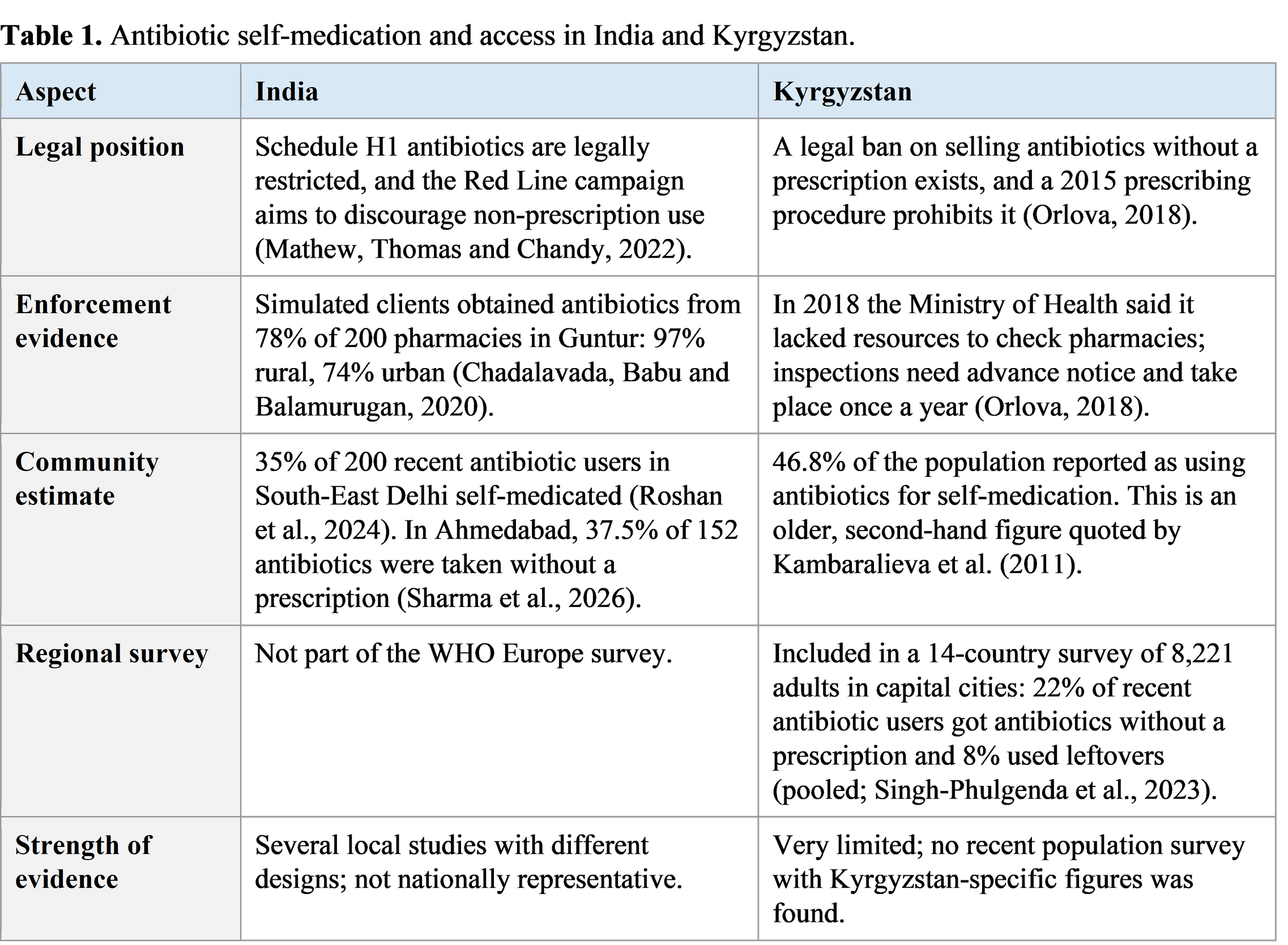
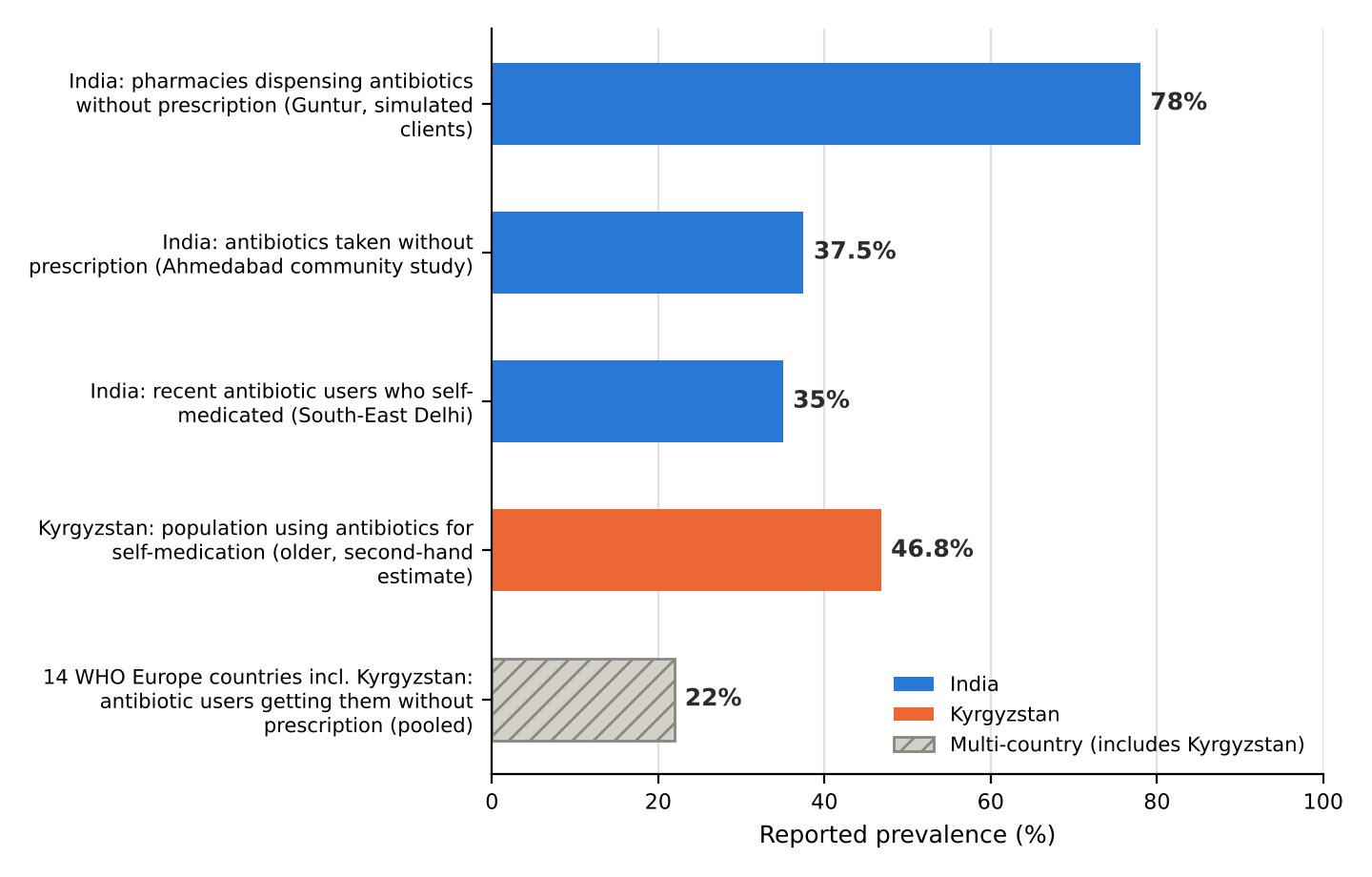
Figure 1. Published indicators of non-prescription antibiotic use. Sources: Chadalavada, Babu and Balamurugan (2020); Sharma et al. (2026); Roshan et al. (2024); Kambaralieva et al. (2011); Singh-Phulgenda et al. (2023). Indicators and populations differ between bars.
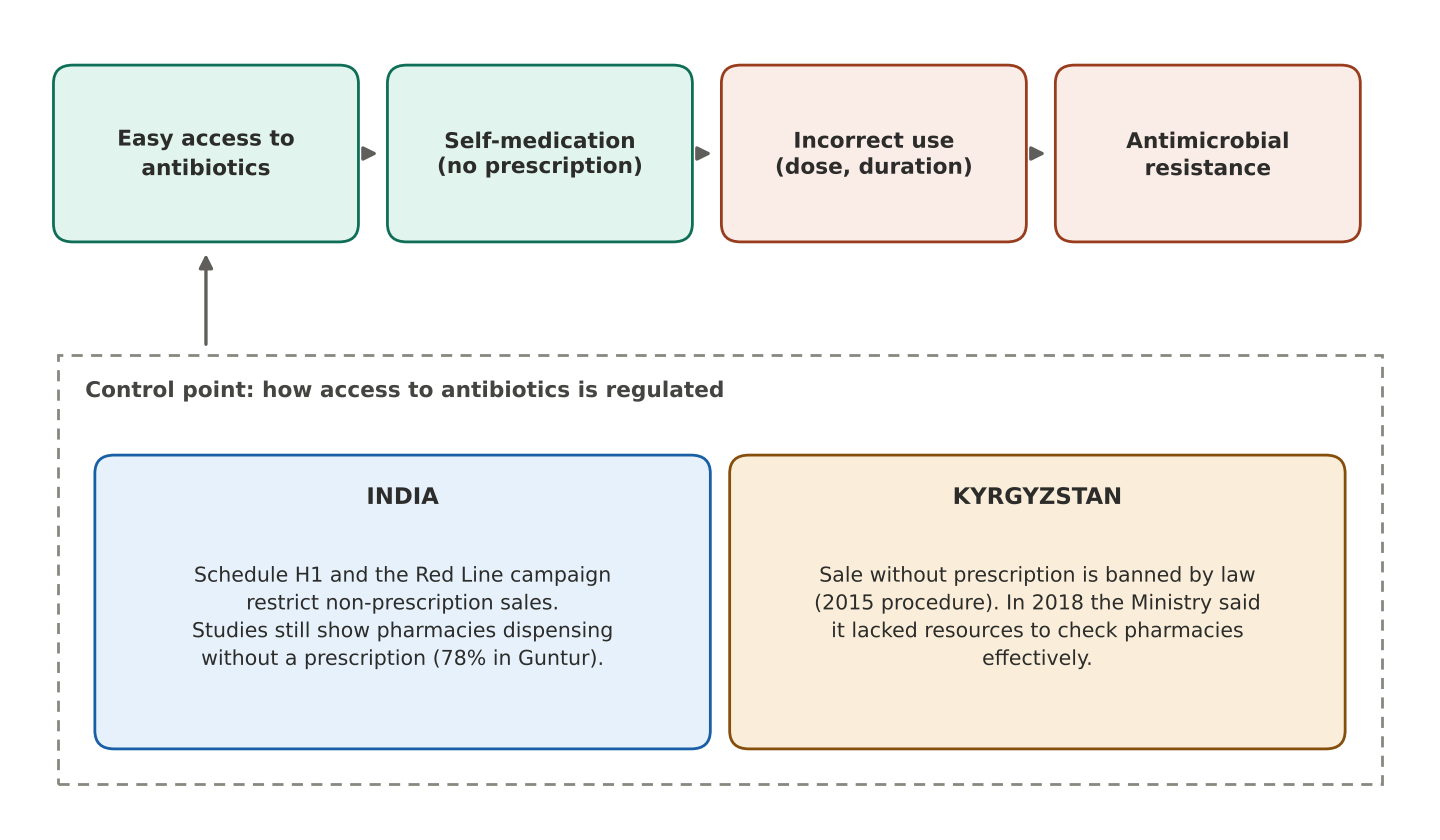
Figure 2. Pathway from easy access to antibiotic resistance and how access is regulated in each country. Based on Mathew, Thomas and Chandy (2022), Chadalavada, Babu and Balamurugan (2020) and Orlova (2018).
4. Discussion
The most obvious similarity is that access at the pharmacy counter appears to be the weak spot in both countries. India has a legal framework and a public awareness campaign, yet simulated clients still managed to obtain antibiotics from most pharmacies in Guntur. Kyrgyzstan has a legal ban, but the Ministry itself admitted in 2018 that it was unable to properly monitor pharmacies.
The key difference lies in the amount of evidence available. India has several local studies, and these reveal variation between locations, such as higher non-prescription dispensing in rural pharmacies. Kyrgyzstan has a single old, second-hand estimate and a regional survey with no published national figure. It is tempting to compare 46.8% with 35% and 37.5% and conclude that Kyrgyzstan is worse, but these are not the same measures. The Kyrgyz figure describes the population, whereas the Indian figures describe recent antibiotic users or the antibiotics they consumed. We therefore cannot determine which country has more self-medication.
Knowledge is also important. In the pooled WHO Europe results, 61% of respondents did not know that antibiotics do not work against viruses (WHO Regional Office for Europe, 2022). This may be similar in Kyrgyzstan, but since the figure is pooled it should be verified with country data. In India, the very low recognition of the Red Line symbol among patients and nurses in Kerala suggests that rules alone do not change behaviour (Mathew, Thomas and Chandy, 2022).
5. Limitations
• Because this is a narrative comparison rather than a systematic review, some studies may have been overlooked.
• The Indian studies are drawn from individual cities and do not represent the country as a whole.
• Since study designs, definitions and populations vary, the percentages cannot be compared on a like-for-like basis.
• The Kyrgyz population estimate is outdated and second-hand, while the WHO Europe figures are pooled across 14 countries and drawn from capital cities.
6. Conclusion and suggestions
Self-medication with antibiotics seems to be widespread in both India and Kyrgyzstan, and both nations have difficulty regulating sales at pharmacies. For Kyrgyzstan, the available evidence is considerably weaker. On the basis of these results, we propose the following:
• Conduct a recent national survey in Kyrgyzstan using questions aligned with the Indian studies, and publish the Kyrgyzstan-specific findings from the WHO Europe survey.
• Employ unannounced pharmacy inspections or simulated-client audits, as was done in Guntur, to gauge enforcement in both countries.
• Expand public education about antibiotics and viral infections, and about what the Red Line marking signifies in India.
References
Chadalavada, V., Babu, S.M. and Balamurugan, K. (2020) ‘Nonprescription sale of schedule H1 antibiotics in a city of South India’, Indian Journal of Pharmacology, 52(6), pp. 482–487.
Kambaralieva, B., Bozgunchiev, M., Zurdinov, A., Harun-or-Rashid, M. and Sakamoto, J. (2011) ‘An assessment of antibiotics prescribed at the secondary health-care level in the Kyrgyz Republic’, Nagoya Journal of Medical Science, 73(3–4), pp. 157–168.
Mathew, P., Thomas, S.A. and Chandy, S.J. (2022) ‘The role of Schedule H1 and Red Line campaign in improving antibiotic use in India’, Journal of Family Medicine and Primary Care, 11(6), pp. 2656–2661.
Orlova, M. (2018) ‘Health Ministry not able to control sale of antibiotics without prescriptions’, 24.kg, 15 November. Available at: https://24.kg/english/101328_Health_Ministry_not_able_to_control_sale_of_antibiotics_without_prescriptions (Accessed: 10 November 2026).
Roshan, J., Aqsa, S., Richa, G. and Nusrat, N. (2024) ‘Prevalence and pattern of self-medication with antibiotics: a community-based cross-sectional study from South-East Delhi’, Indian Journal of Community Medicine, 49(7).
Sharma, R., Patel, P.N., Patel, N.R., Gajjar, S.A., Patel, B.P., Chandegara, A. and Bapat, N.K. (2026) ‘A community-based study of antibiotic consumption in an urban health training centre area of Ahmedabad city’, Indian Journal of Medical Research, 163(3), pp. 327–333. doi:10.25259/IJMR_452_2025.
Singh-Phulgenda, S., Antoniou, P., Lo Fo Wong, D., Iwamoto, K. and Kandelaki, K. (2023) ‘Knowledge, attitudes and behaviors on antimicrobial resistance among general public across 14 member states in the WHO European region: results from a cross-sectional survey’, Frontiers in Public Health, 11. doi:10.3389/fpubh.2023.1274818.
WHO Regional Office for Europe (2022) 1 in 3 use antibiotics without prescription, WHO/Europe’s study shows. News release, 21 November. Available at: https://www.who.int/europe/news/item/21-11-2022-1-in-3-use-antibiotics-without-prescription--who-europe-s-study-shows (Accessed: 10 November 2026).